

The storefront is only part of the opportunity
A retail leasing presentation can show a beautiful facade and still leave an operator with important questions about the customer journey.
How would someone notice the business? From which approach? What nearby uses might create a reason to visit? How do access, visibility and the intended operation fit together?
These questions deserve a place beside the space information. They help the prospect evaluate the location in relation to its own business model.
The marketing should distinguish documented conditions from hypotheses. A plausible customer occasion is a useful discussion point. It is not proof of future sales or demand.
Walk the approaches you intend to describe
Inspect the actual routes from relevant parking, sidewalks, nearby buildings and other access points. Record where the storefront becomes visible and where a visitor may need guidance.
Use dated photographs and a clear site plan. Explain which approach each asset shows. A dramatic image from a favorable angle may be attractive without representing how many visitors encounter the property.
Check the current facts with the responsible team before publishing. Access arrangements, neighboring occupancy and construction conditions can change.
The purpose of the walk is to identify what the presentation can accurately demonstrate and which questions remain. It should not become an informal traffic study dressed up as quantitative evidence.
Develop a customer occasion as a hypothesis
Consider an illustrative mixed-use location with occupied offices, residences and a public-facing storefront. A daytime meal, an appointment or an errand could be relevant visit occasions for some operators.
Describe the conditions that make each occasion plausible. Then identify what is still unknown: actual customer behavior, demand at particular times or how the operator’s offer would perform there.
Do not infer guaranteed spending from nearby occupancy. The presence of people and the likelihood they will buy from a particular business are different questions.
A useful retail story shows the route to a possible visit and leaves the operator room to evaluate the business case.
Use the hypothesis to organize a conversation, not to substitute for the prospect’s own due diligence.
Read the framework as text
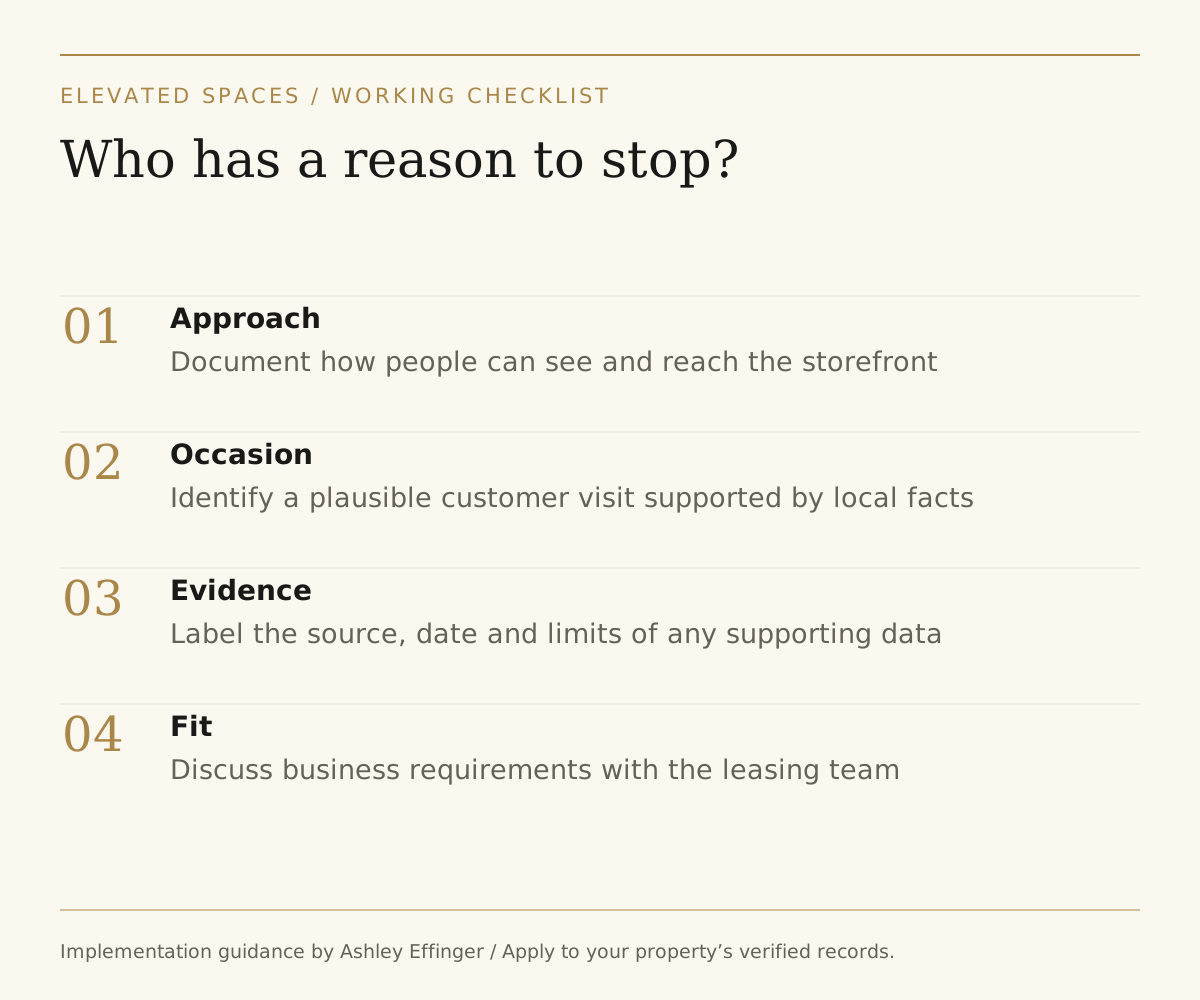
Practical review checklist. Approach: Document how people can see and reach the storefront. Occasion: Identify a plausible customer visit supported by local facts. Evidence: Label the source, date and limits of any supporting data. Fit: Discuss business requirements with the leasing team.
Give numbers their full context
If the presentation includes traffic, demographic, visitation or other market information, include the source, date, geographic scope and relevant definition. Distinguish a roadway count from pedestrian activity and observed visits from unique customers.
Explain what the data can and cannot support. A number collected for one purpose may not answer the operator’s actual question.
When current, suitable data is unavailable, use a clearly labeled qualitative observation or leave the claim out. An unsupported large number can weaken an otherwise credible presentation.
Show neighboring uses accurately and avoid implying a business is open, committed or remaining at the location unless the team can confirm it. The surrounding context should be as current as the available-space brief.
Connect the story to the leasing process
Pair the customer journey with verified space specifications and a clear discussion of the operator’s requirements. The broker can help identify which questions need further review and which conditions the property can confirm.
Build campaign assets around one useful angle at a time. A storefront approach diagram, a documented neighboring-use map and a current space plan have different jobs. Give each a caption that explains its relevance.
Record the inquiries and recurring questions the campaign generates. Use them to improve the information package rather than assuming interest proves tenant fit.
The proposed Commercial Leasing Campaign Planner will help organize that brief and response process. It is not available yet; subscribe for future tools.
Retail leasing needs a compelling story about the space. It also needs an honest account of how a customer might encounter it.
Property Photography & Content Brief Builder
Turn prospect questions into purposeful shot lists, clear creative briefs and organized asset handoffs.
Get the Brief Builder