

Availability begins the conversation
The square footage is there. The address is there. The broker’s contact details are there.
What is missing is an explanation of why a business should investigate this particular opportunity.
Commercial leasing marketing needs accurate specifications, but a specification list is only part of the assignment. The campaign should connect the space to a relevant use, show the supporting evidence and make the next step clear.
Start with a question the tenant is likely to bring to the search. Then determine which verified facts help answer it. The result should be more useful than a louder version of “now leasing.”
Build a space brief before the campaign
Confirm current availability, configuration, property information and the conditions the team is authorized to communicate. Identify who maintains the facts and how changes reach marketing.
Work with the broker to distinguish a possible use from an approved or confirmed one. Do not imply a particular business can occupy the space without the relevant review.
An illustrative office brief might identify a suite with a verified meeting area and an understandable visitor route. A retail brief might focus on storefront visibility from a documented approach. Those are starting points for evaluation, not guarantees of business performance.
List the questions still pending. The campaign can provide a route to discuss them without presenting uncertainty as a completed fact.
Develop one useful campaign angle
Choose a requirement the space can support and assemble the evidence. A business evaluating client-facing space may need to understand arrival, suite access and how visitors reach the relevant destination.
Build the story around those facts. Use a current route diagram, clear photographs and the correct suite information. Keep decorative language subordinate to the practical explanation.
Write the next step to match the question. A prospect reviewing a configuration may need a plan or a discussion with the broker. Someone ready to visit needs a clear tour request route.
The campaign’s job is to make the opportunity easier to evaluate, one relevant question at a time.
Avoid stacking unrelated benefits into a single claim. A focused angle can sit alongside a complete property information page without pretending to describe every possible tenant need.
Read the framework as text
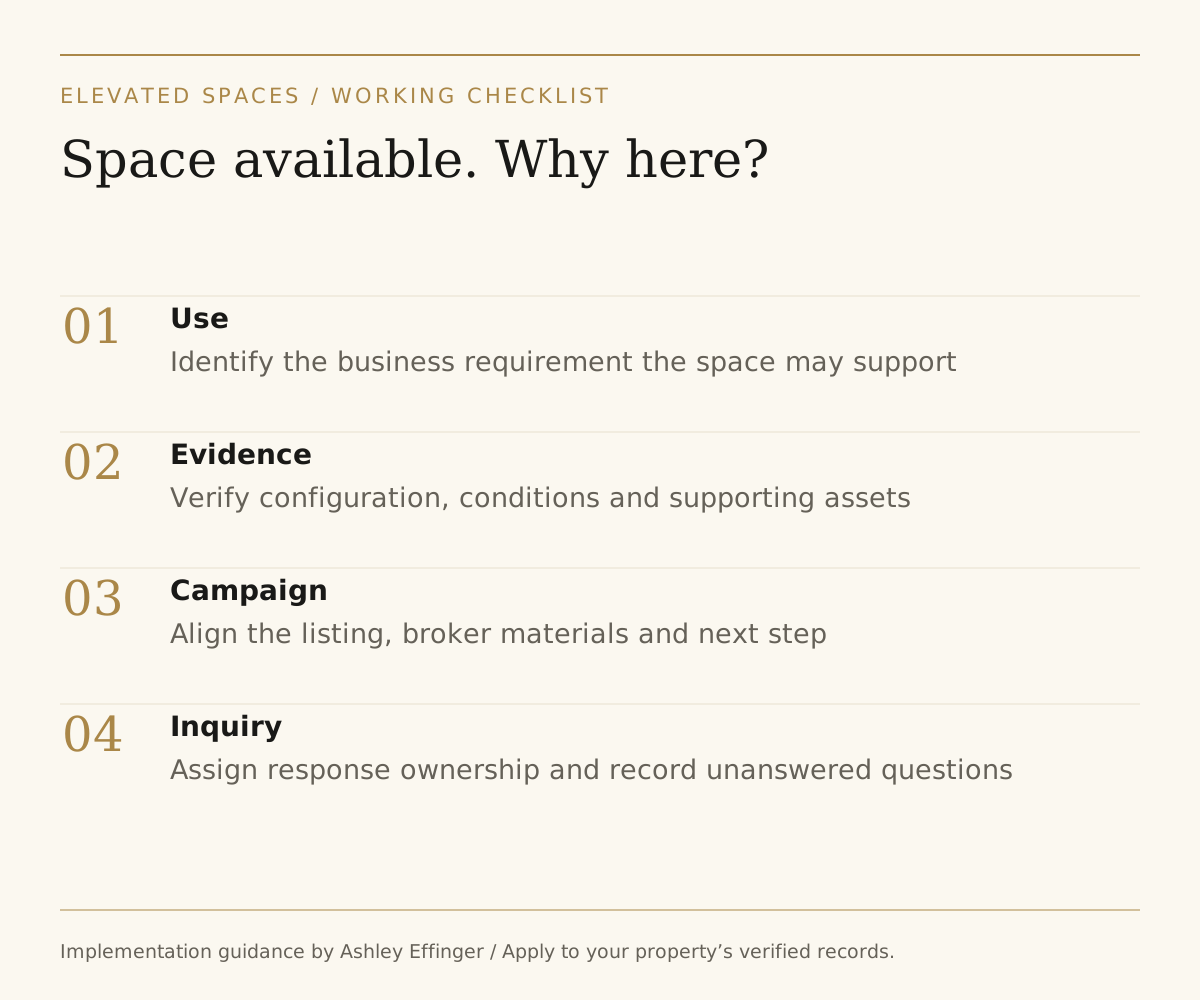
Practical review checklist. Use: Identify the business requirement the space may support. Evidence: Verify configuration, conditions and supporting assets. Campaign: Align the listing, broker materials and next step. Inquiry: Assign response ownership and record unanswered questions.
Coordinate the handoff with the broker
Agree on where inquiries arrive, who responds and how the team records the result. Marketing should know which campaign generated a question when that information is available and reliable.
The broker should receive the relevant campaign context. A prospect responding to a specific suite or use case should not have to explain the entire premise again.
Create a feedback route for recurring questions and unsuitable inquiries. If the campaign repeatedly attracts requirements the space cannot serve, examine the message and information path before adding spend.
Confirm how availability changes will be communicated. An attractive campaign becomes unhelpful quickly when its featured space is no longer available and the next step has not been updated.
Report what the campaign actually revealed
Track the measures your process can substantiate: inquiries, response completion, tours and recurring requirements. Define stages consistently and distinguish unique opportunities from repeated contacts.
A campaign can provide useful learning even when a leasing decision takes longer than the reporting period. Show what questions emerged, what information was missing and which next action the team recommends.
Do not turn inquiry volume into a promise about lease outcomes. Pricing, space requirements, timing and other conditions remain part of the decision.
The Commercial Leasing Campaign Planner is available now to organize the brief, campaign channels, broker handoff and inquiry follow-through.
Availability tells the market that an opportunity exists. A useful campaign helps the right business understand whether it deserves a closer look.