

The meeting ends with another meeting
The slides contain traffic, leads, spend and activity. Someone asks what the team recommends. The answer is that more analysis is needed.
Sometimes that is appropriate. The available evidence may not support a decision. But a report should explain the uncertainty and the next investigation clearly enough to move the work forward.
A dashboard becomes more useful when it leads to a specific request: approve an action, choose between alternatives, resolve a constraint or authorize a bounded test.
Start with that decision. Then include the evidence necessary to evaluate it. Leadership should not have to reverse-engineer the request from a sequence of charts.
Define the observation before explaining it
Use the metric’s name, definition, source and period. Distinguish a change in counts from a change in rates. Explain any relevant change in tracking or operational conditions.
Imagine that inquiries increased while completed tours remained flat. That observation raises questions about inquiry quality, contactability, response handling, scheduling and inventory. It does not establish which one caused the gap.
The report should preserve that distinction. State what is known, what is suspected and which record would help resolve the uncertainty.
If the underlying data is incomplete, say so. A smaller, accurate decision brief is more useful than a confident recommendation resting on numbers the team cannot reconcile.
Present a bounded recommendation
For the illustrative inquiry-to-tour gap, the recommendation might be to review a defined sample of recent inquiries with leasing before increasing campaign spend. Specify the period, the records required and the questions the review should answer.
Offer a relevant alternative, such as proceeding with an existing campaign plan while acknowledging the unresolved conversion issue. Explain the tradeoff in time, cost and what the team will learn.
Avoid giving every possible action equal weight. Make the recommended choice visible, along with the condition that would change your view.
A decision request should make it possible to approve the next action without approving an unsupported explanation.
If the evidence justifies a test, define its scope. A limited operational review and a portfolio-wide campaign change require different levels of confidence.
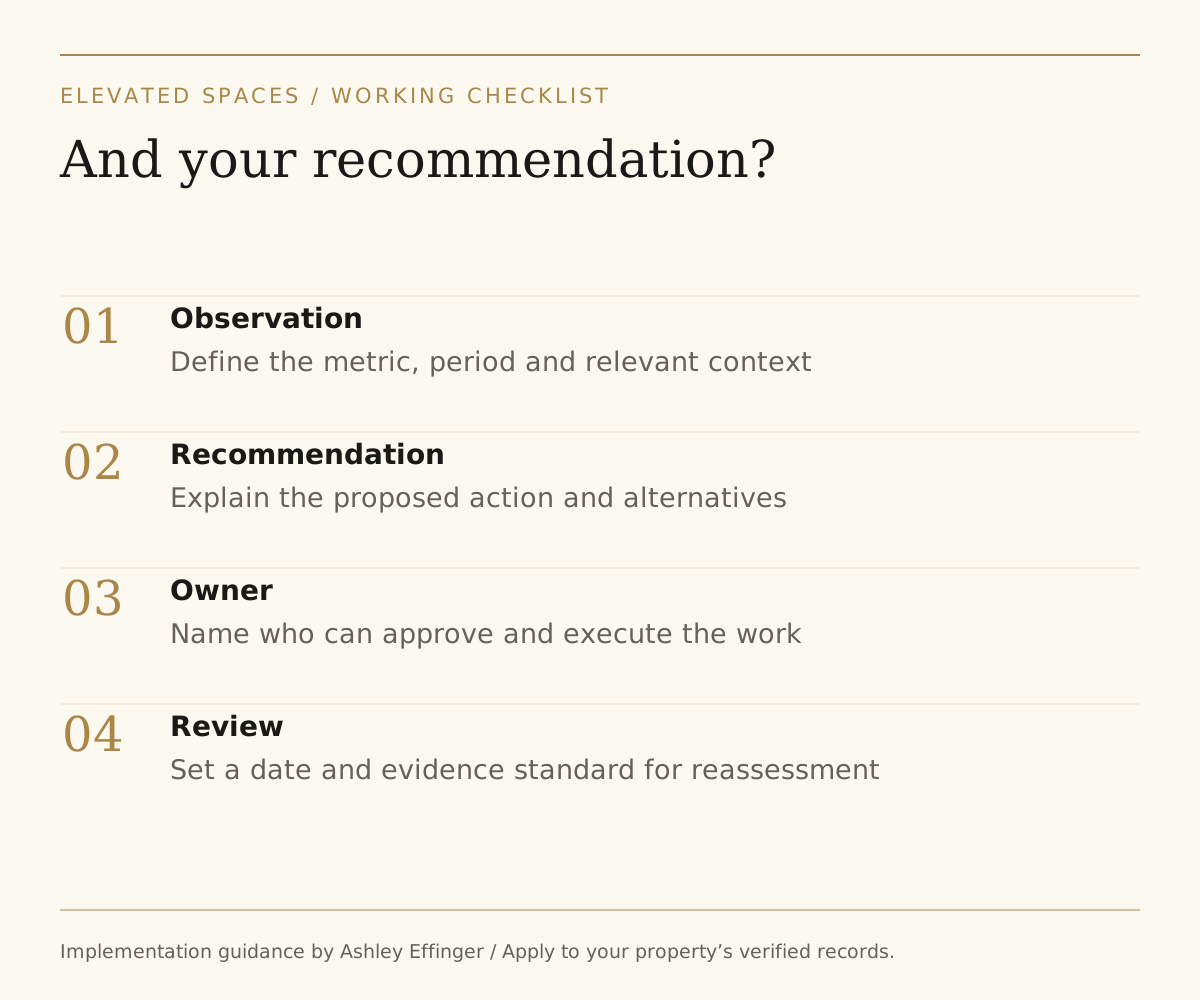
Read the framework as text
Practical review checklist. Observation: Define the metric, period and relevant context. Recommendation: Explain the proposed action and alternatives. Owner: Name who can approve and execute the work. Review: Set a date and evidence standard for reassessment.
Give the action an owner and a route
Name the role responsible for approval and the person or team responsible for execution. Marketing may identify a handoff issue without controlling the scheduling process that needs review.
List the dependencies. Does leasing need time to reconcile records? Does the property need to confirm readiness? Does a vendor need to explain a tracking discrepancy?
Attach a realistic next update. “Monitor performance” is incomplete unless the team knows who is monitoring, what they will examine and when the findings return to the decision-maker.
Record the decision itself. An approved request should not vanish into meeting notes while the next report repeats the same unresolved recommendation.
Define what would count as progress
Choose measures appropriate to the action. A record review may succeed by identifying where information is missing. A revised scheduling process may need evidence that promised contacts occurred and appointments were accurately recorded.
Keep those process results separate from later leasing outcomes. Improvement in a short period may coincide with pricing, inventory or staffing changes. Explain that context rather than assigning the entire result to the latest marketing action.
At the review date, recommend whether to continue, change or stop the action. Document what the team learned even if the result was inconclusive.
Executive Marketing Performance Brief can help organize this decision structure. Bring the observation, recommendation, owner and review standard into the same brief.
The report should leave the room with an assignment someone can actually complete.
What makes a property marketing report actionable?
An actionable report names the observation and its data source, separates fact from hypothesis, recommends a bounded response, identifies the approval and execution owners, and states when the outcome will be reviewed. It should also explain what evidence would change the recommendation.
The Executive Marketing Performance Brief structures the decision request. When metrics need clearer definitions before that discussion, pair it with the Multifamily Marketing KPI Dictionary.
Multifamily Marketing KPI Dictionary
Agree on what the metric counts before interpreting the result or deciding the next action.
Get the KPI Dictionary