

Write the question before ordering the assets
“We need a campaign.”
A reasonable request. Until the brief becomes an email, three posts, a reel, a flyer and a meeting to discuss why everything is suddenly urgent.
What decision are we trying to help somebody make? Which inventory needs attention? What does the prospect need to understand that the current marketing has failed to explain?
If the team cannot answer those questions, the production schedule is carrying a strategy-shaped vacancy.
Begin the brief with a specific question. Which available inventory needs clearer consideration?
What uncertainty prevents a prospect from taking the next step? What changed that makes this campaign useful now?
Use the current inventory picture and direct observations from leasing to answer, rather than starting with a theme someone happens to like.
Write the intended action in plain language. “Help visitors compare two available layouts and book an informed tour” gives the team more direction than “drive awareness.” The broader brand objective can remain relevant, but this particular campaign needs a job that its assets can reasonably support.
Keep the brief to one page at first. If the objective takes several paragraphs to explain, the team may be trying to solve too many problems in one campaign.
Choose the problem that matters most before multiplying the deliverables.
Put the proof beside the promise
The creative concept should make accurate value easier to see. If the advertised home is not ready or the proposed service cannot be verified, the brief needs correction before it needs a mood board.
Separate the message from its proof. A headline might promise a more workable daily routine.
Its proof could include an accurate floor plan, specific room dimensions and a clear explanation of access to shared facilities. The creative concept should make that evidence easier to understand.
Add the boundaries that matter to execution: terms that must be visible, images that need qualification, current limitations and the person authorized to answer an unresolved question. This is practical production context, not an invitation to bury the message in internal notes.
Where the evidence is weak, change the brief before asking design to make it persuasive. Visual polish can help a strong claim become memorable.
It cannot make a nonexistent service, outdated price or unavailable home into an accurate promise.
Busy is a production status. It is not a strategy.
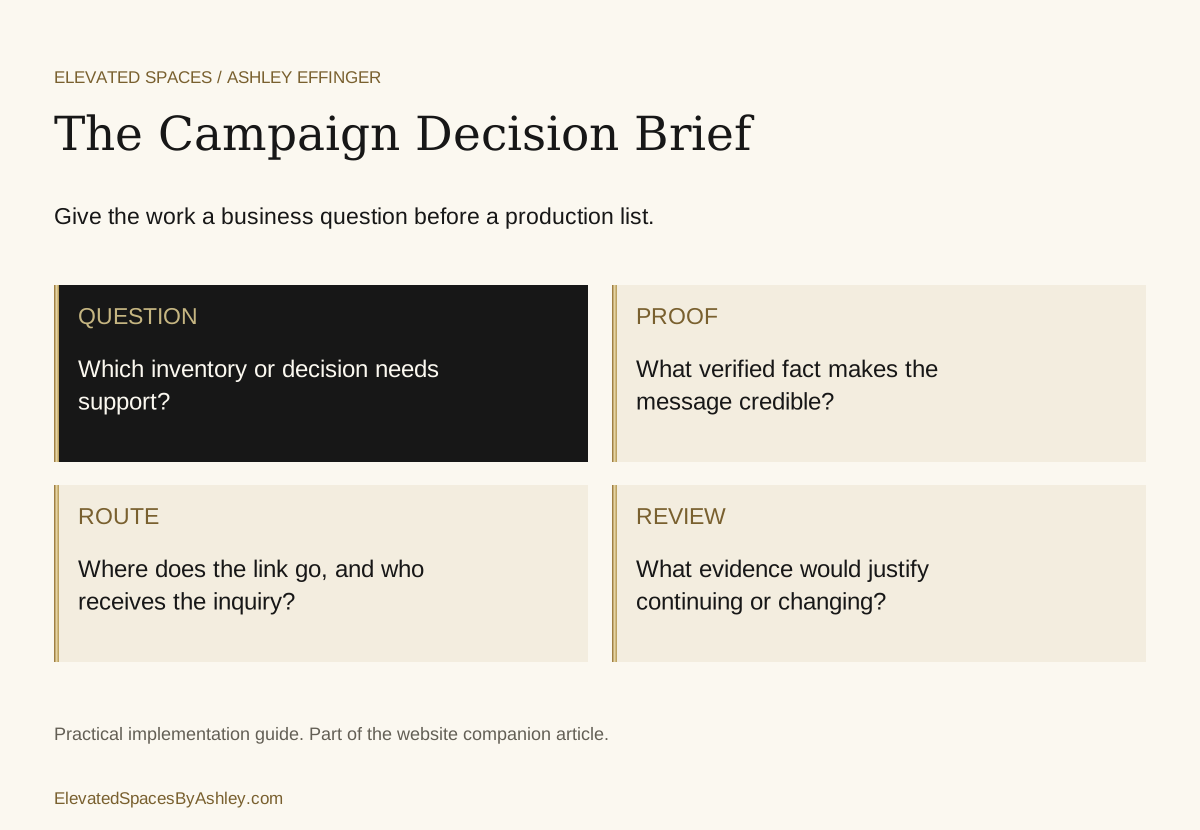
Read the framework as text
The Campaign Decision Brief. QUESTION: Which inventory or decision needs support?. PROOF: What verified fact makes the message credible?. ROUTE: Where does the link go, and who receives the inquiry?. REVIEW: What evidence would justify continuing or changing?
Follow the click all the way to a person
The ad is not the whole campaign. The landing page, inquiry route and receiving colleague are in it too, whether they were invited to the kickoff or not. Name the handoff before paying to create more of them.
Ask what the prospect should already understand when the inquiry reaches leasing. The answer informs the landing page.
Ask what the team needs to know about the inquiry to respond usefully. The answer informs campaign labeling and internal notes.
Neither question is resolved by adding a more prominent button alone.
Give exceptions an owner. If the advertised home becomes unavailable, who updates the page and informs the team?
If the named host is absent, who covers the appointment? If an offer changes, which assets must be revised together?
A short responsibility list prevents small inconsistencies from becoming a public experience.
The brief should also state what will not be produced in this round. A focused campaign may need one excellent landing page and a few distribution assets.
A longer deliverables list is not evidence of a stronger strategy.
Choose what would change your mind
Define the review question before launch. Otherwise, teams can choose whichever number looks nicest afterward. A useful brief states the action, the evidence, the owner and the condition that would justify a different approach.
Set a review date that gives the team time to observe the intended behavior. Do not promise a statistically meaningful result from a handful of interactions.
Small samples can identify practical problems and generate hypotheses; they cannot justify every performance claim a dashboard makes easy to display.
At review, record what changed, what remained uncertain and what the team will do next. Keep pricing, availability and operational changes visible so the campaign is not credited or blamed for every movement in the result.
A useful brief makes these limitations explicit early.
From Vacancy to Campaign™ turns this brief into a coordinated 30-day multifamily campaign, with verified inventory, channel plans, daily actions and review windows. Begin with five lines: question, proof, route, owner and review.
If those lines are unclear, the next valuable task is usually clarification rather than another round of creative.
What belongs in a one-page property campaign brief?
Start with the inventory or business decision the campaign supports. Write the prospect question, verified proof, destination and handoff owner, then the specific review date and evidence that would justify a change. Only then choose formats such as email, paid media, landing-page content and social posts.
When a campaign needs a coordinated month of execution, From Vacancy to Campaign™ provides a practical planning sequence. For assets that must answer a visual question, use the companion photography briefing method.
Multifamily Marketing Command Center
Connect campaigns, content, assets, handoffs and reported results.
Get the Command CenterRelated published work
Continue with Ashley’s original articles. This website companion focuses on practical implementation.
- PPC Clicks Don’t Lease Apartments. Alignment Does. · Elevated Spaces on LinkedIn