

Answer the next client’s evaluation question
“We delivered exceptional results.”
Excellent. Which results? Measured how? Over what period? What changed besides the marketing?
A case study should answer those questions before the reader has to ask them. The next client is evaluating how you think, not simply whether you know where the gold trophy emoji lives.
Show the starting condition, the decision you made, the work that followed and the evidence you are authorized to share. That is where a project becomes proof.
Start with the reader’s likely question. Can this team understand a complex property offering?
Can it coordinate marketing with the operating reality? Can it explain a result without hiding the difficult parts?
The case should provide evidence relevant to that question.
Choose a project you are authorized to discuss. Establish which details, assets and results can be published before writing around them.
If confidentiality limits specificity, explain the scope in a way that remains accurate rather than inventing numbers or combining different projects into an unlabeled success story.
The structure can work across commercial real estate. An office leasing initiative, a retail property repositioning and a multifamily campaign have different facts, but each involves a problem, a decision and evidence.
Keep the narrative grounded in the actual project.
Show the choice, not just the output
Explain the constraint and the alternative. Why this route, this audience question or this presentation system? The reasoning is part of the expertise the buyer is assessing.
Explain the options considered and why the team chose its approach. A focused landing page, a revised presentation system or a different campaign sequence becomes more meaningful when the reader understands the constraint it addressed.
The reasoning is part of the expertise being demonstrated.
Show selected work that supports the explanation. A before-and-after comparison can be useful when it identifies the relevant change accurately.
A decorative montage may be attractive but leave the reader unable to judge what improved or why it mattered.
Label illustrative reconstructions clearly if original assets cannot be shown. Do not present a mockup as evidence of a live campaign or a measured result.
A restrained, accurate explanation is more credible than an elaborate visual that obscures the source of the proof.
A good case study makes the judgment visible, not just the finished work.
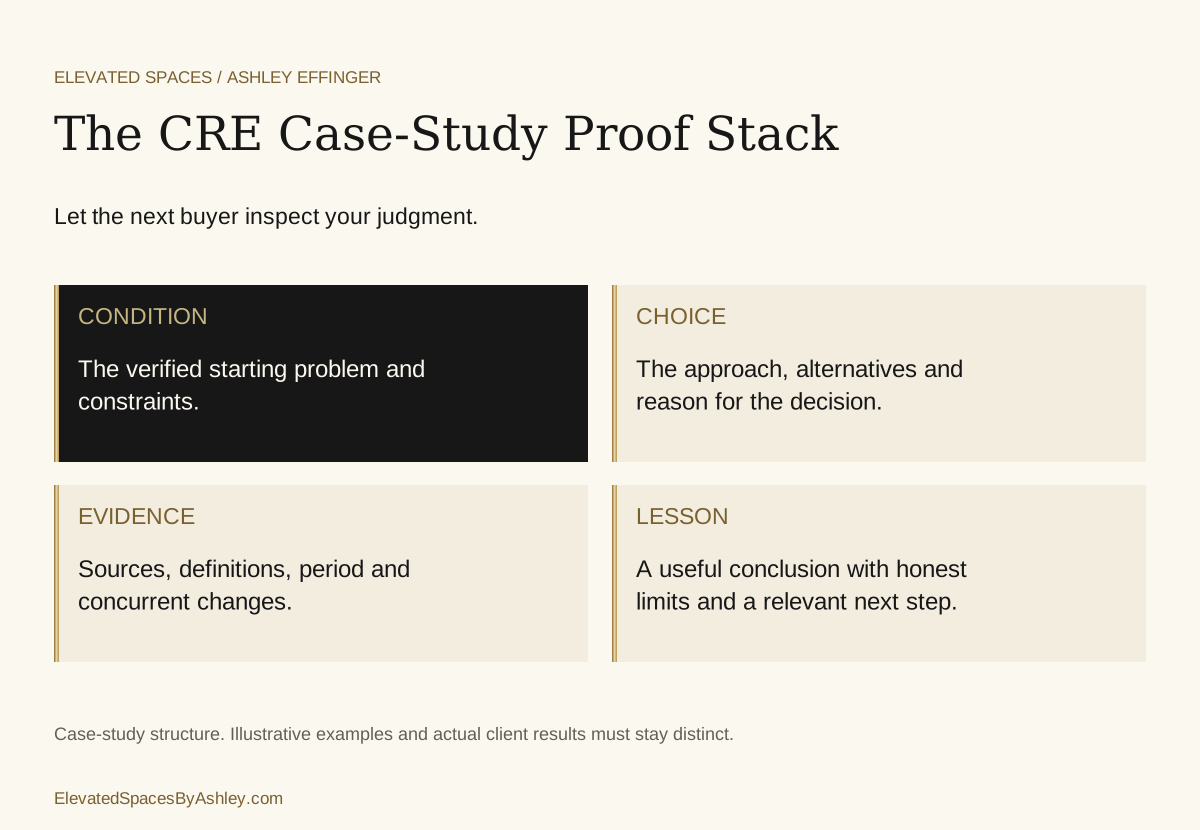
Read the framework as text
The CRE Case-Study Proof Stack. CONDITION: The verified starting problem and constraints.. CHOICE: The approach, alternatives and reason for the decision.. EVIDENCE: Sources, definitions, period and concurrent changes.. LESSON: A useful conclusion with honest limits and a relevant next step.
Give every result a measurement context
A percentage without a source, period and denominator is a decorative number. Separate observed association from demonstrated causation. If the evidence is qualitative, describe that achievement concretely instead of inventing a metric.
Include relevant conditions that changed during the project. Pricing, inventory, readiness, staffing and market context may affect interpretation.
A reader does not need every internal detail, but they need enough context to understand the limits of the result.
When quantitative evidence is unavailable, use a clearly described qualitative outcome rather than inventing a percentage. The team may have established a consistent approval process, resolved an information gap or produced a reusable asset system.
Those achievements can be explained concretely.
Avoid presenting a single project as a universal guarantee. A case study demonstrates how the team approached a particular situation.
The reader should leave with a better understanding of your reasoning, not an expectation that the same output will produce the same result everywhere.
End with a transferable lesson
A useful lesson travels without pretending the same asset will produce the same outcome everywhere. State the condition under which the method applies and the next step a relevant reader can take.
Connect the case to an appropriate resource, service or future conversation. The next step should match what the reader has just evaluated.
Someone investigating a reporting problem may need a practical brief rather than a broad invitation to explore everything you offer.
Review the finished case with the people responsible for factual accuracy and publication permission. Check captions, asset usage and any qualifications around results.
Keep the approval record with the source material so future revisions do not strip away important context.
The planned Executive Marketing Performance Brief can help organize the evidence before it becomes public storytelling. Begin with the decision and the proof.
A case study earns its place in a commercial real estate editorial library when it helps another person evaluate how you think.
CRE Property Positioning Toolkit
Connect a documented tenant requirement to verified property facts and a clearer message hierarchy.
Get the Positioning ToolkitCommercial Leasing Campaign Planner
Coordinate the brief, channels, broker handoff, inquiry follow-through and results for one commercial property campaign.
Get the Campaign Planner