

The label does not finish the explanation
Class A. Premier location. Exceptional amenities.
A property can use all three phrases and still leave a tenant wondering why this building deserves a place on the shortlist.
The description needs a practical argument. Which business requirements can the property support? What experience will employees, clients or visitors encounter? What can the team show to substantiate the answer?
A classification can provide context, but it does not replace the work of positioning. Start with the tenant’s decision and the building’s verified capabilities. That gives marketing, ownership and brokers a shared foundation for the conversation.
Identify a requirement the property can serve
Work with the leasing team to review actual inquiries, current availability and recurring evaluation questions. Focus on business uses and requirements rather than a fictional tenant personality.
Examples might include a clear visitor arrival, access to meeting space, a particular suite configuration or proximity to services the tenant values. Each needs verification and context.
Do not assume every business wants the same workplace experience. A feature may matter to one prospect and have little relevance to another. Positioning should identify where the property is a good fit, while leaving room for specific needs to be assessed.
Choose a requirement the team can explain clearly. “Supports businesses that value an understandable client arrival” is more workable than “perfect for every modern company.”
Connect the requirement to observable evidence
Imagine a building with a clearly signed visitor entrance, documented parking instructions and a straightforward route to the reception point. Those facts can support a message about arrival clarity.
They do not establish that every visitor will find the journey effortless. The team should walk the route, verify instructions and identify exceptions such as after-hours access.
Choose evidence that helps the tenant evaluate the benefit: photographs of the approach, an accurate arrival map or a documented process. A decorative lobby image may support the visual story without answering the practical question.
A building’s strongest argument is a relevant benefit that the team can explain and demonstrate.
Record the source and review date. Property positioning should change when the supporting condition changes.
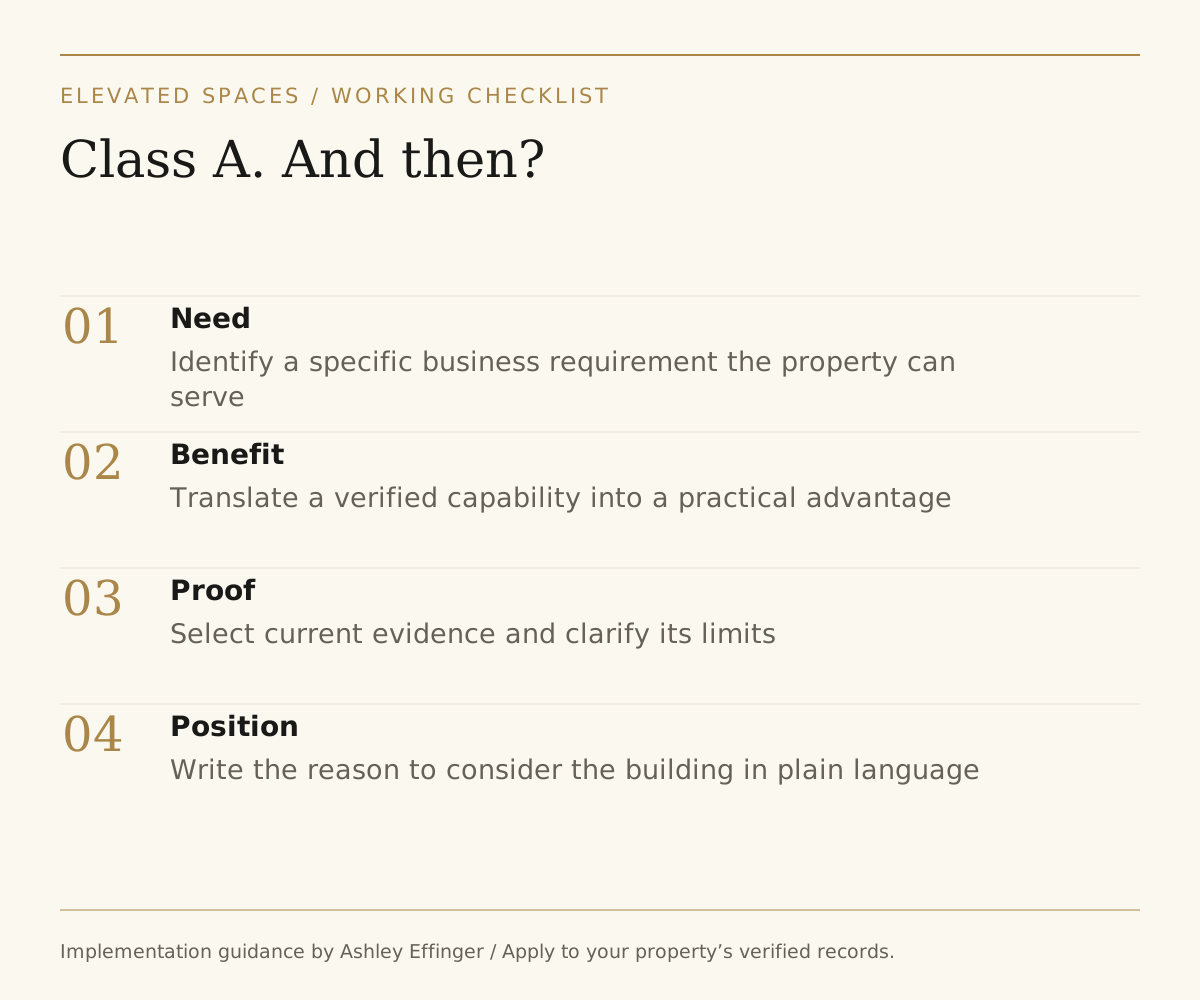
Read the framework as text
Practical review checklist. Need: Identify a specific business requirement the property can serve. Benefit: Translate a verified capability into a practical advantage. Proof: Select current evidence and clarify its limits. Position: Write the reason to consider the building in plain language.
Write the position before the campaign line
Use a working sentence: “For businesses that need [requirement], this property offers [verified capability], supported by [evidence].” This is an internal planning tool, not necessarily the final headline.
Test it with the broker and operating team. Can they point to the supporting facts? Are any conditions missing? Does the statement describe a meaningful reason to consider the building?
Then develop public language appropriate to the channel. A listing, presentation and website can express the same position differently while using consistent evidence.
Compare the statement with nearby alternatives using current, verifiable information. Avoid broad superiority claims the team cannot support. A focused reason to consider the property is valuable without declaring it the best building in the market.
Keep the argument close to the experience
Bring the position into the tour, broker materials and follow-up. If visitor arrival is central to the story, the tour should make that process understandable and the follow-up should provide the relevant information.
Review prospect questions after the position is introduced. Do people understand the benefit? Are they asking for evidence the materials do not contain? Is the property attracting inquiries it cannot serve?
Those observations can guide the next revision. They are signals to investigate, not automatic proof that the positioning caused a leasing result.
The CRE Property Positioning Toolkit is available now to help organize the tenant requirement, verified evidence and message review.
Your building may have a strong classification. Give the tenant an equally clear reason to care.
Commercial Leasing Campaign Planner
Coordinate the brief, channels, broker handoff, inquiry follow-through and results for one commercial property campaign.
Get the Campaign PlannerProperty Photography & Content Brief Builder
Turn prospect questions into purposeful shot lists, clear creative briefs and organized asset handoffs.
Get the Brief Builder