
The same feature can answer different questions
A meeting room is one feature. It can raise several questions.
One business wants to understand client arrival and presentation conditions. Another needs to know how employees can reserve shared space. Another is evaluating whether its own suite must accommodate every meeting.
The building has not changed. The evaluation question has.
That is the opportunity for more useful commercial messaging. Instead of building a single description broad enough to please everyone, identify a small set of business requirements the property can support and give each one a clear explanation.
The facts should remain consistent across the versions. The emphasis can change.
Use requirements as the organizing principle
Review inquiries and broker conversations for recurring needs. Work with the leasing team to distinguish a verified requirement from an internal assumption about a category of business.
Examples could include visitor access, suite layout, meeting arrangements, operating hours or a particular space constraint. Do not assume every firm in one industry values the same feature in the same way.
Create a short requirement brief: the question, the property capability, the evidence and the unresolved conditions. Keep the language practical enough that the broker can use it in a conversation.
If the property cannot substantiate an answer, identify the missing information. A campaign should not solve an incomplete brief by inventing an ideal tenant.
Build three messages from one verified feature
Imagine a building with bookable shared meeting rooms. Confirm the current booking process, access conditions, equipment and any limitations before writing the campaign.
A client-arrival message might explain where guests enter and how they reach the room. A team-use message might explain the reservation process and room setup. A space-planning message might invite a discussion of how the shared resource relates to the suite being considered.
Each version needs supporting information. None should imply guaranteed availability or savings the team has not established.
Different messages should reveal different relevance, not different versions of the truth.
The same photograph might support more than one version, but the caption, companion asset and next step may need to change.
Read the framework as text
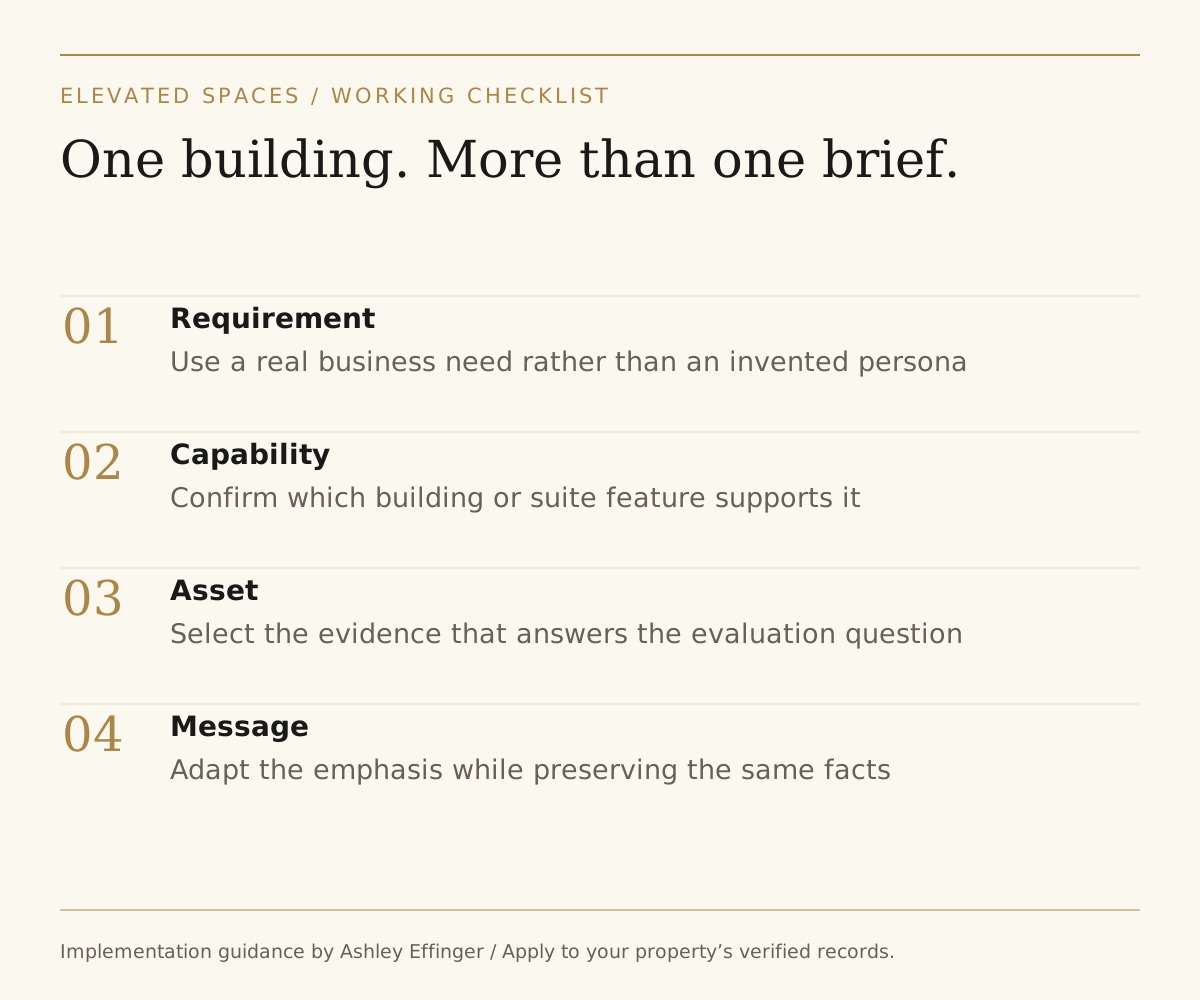
Practical review checklist. Requirement: Use a real business need rather than an invented persona. Capability: Confirm which building or suite feature supports it. Asset: Select the evidence that answers the evaluation question. Message: Adapt the emphasis while preserving the same facts.
Match the next step to the question
A visitor evaluating a layout may need a current plan. Someone investigating client access may need an arrival guide. A business with operating-hour requirements needs a direct, verified answer from the appropriate contact.
Avoid sending every message to a generic page that makes the person start again. Place the relevant information together or make the route obvious.
Give brokers the message variants and the evidence behind them. Invite feedback when the emphasis does not match what prospects are actually asking.
Keep a central fact record so changes reach every version. If a shared-space policy changes, an outdated campaign should not continue promising the old arrangement simply because it was filed under another audience.
Evaluate inquiry fit as well as activity
Track which questions each message generates and whether the property can serve the resulting requirements. A busy campaign is not automatically a useful campaign.
Define what the team means by a relevant inquiry and record the basis consistently. Preserve the distinction between a business requirement and a judgment about a person.
Compare observations over a reasonable period with context such as inventory, channel and the amount of promotion. A difference in response may reflect several conditions, so treat the findings as evidence for the next review rather than a final verdict.
Use the CRE Property Positioning Toolkit to organize these requirement-to-message decisions. Begin with three recurring business questions and the building facts that answer them.
One property can support several meaningful conversations. Marketing should help the broker start the right one.
Tenant Experience & Engagement Planner
Organize useful tenant communications, purposeful events, accountable feedback and evidence-based reviews.
Get the Tenant Experience Planner