

The useful part may be buried in the sentence
“Great community” is pleasant to read. “Someone explained the move-in process before I had to ask” tells a marketer something more specific.
Reviews and resident feedback can reveal which details people notice, how they describe value and where their experience differs from the property’s preferred language. They offer questions worth investigating before another round of copywriting.
They are also an incomplete view. A review platform represents the people who posted there, during a particular period, under particular circumstances. It does not provide permission to make universal claims about the community.
Use feedback as a source of hypotheses and language, then verify what you intend to say.
Build a small theme inventory
Choose a defined set of recent feedback and record its source and period. Read positive and critical comments. Look for recurring experiences rather than collecting adjectives that flatter the property.
Useful themes could include clear communication, responsive updates, a comfortable shared workspace or confusing arrival instructions. Preserve enough context to distinguish different issues. A compliment about a maintenance team member is not automatically evidence of a property-wide response-time standard.
Count themes consistently if you choose to quantify them. State whether you counted comments, respondents or mentions. One person mentioning parking three times should not silently become three residents.
Keep the working inventory internal and follow your organization’s practices for handling resident information. You do not need to publish identifiable comments to learn from them.
Verify the experience behind the praise
Imagine several recent comments mention helpful move-in guidance. Before writing “a seamless arrival, every time,” inspect the process. Is the guidance standardized? Is it current? Can the team deliver it when staffing or arrival times vary?
A more supportable claim might describe what the property actually provides: a move-in guide, confirmed arrival instructions and a named contact for questions. Those details give prospects something concrete to evaluate.
If the experience depends on one person improvising, the immediate opportunity may be an operating improvement. Document the useful behavior before turning it into a prominent promise.
A compliment is a lead for your investigation. The verified experience is the foundation for your claim.
Check critical themes with the same seriousness. They may expose the exception that makes a broad marketing statement unreliable.
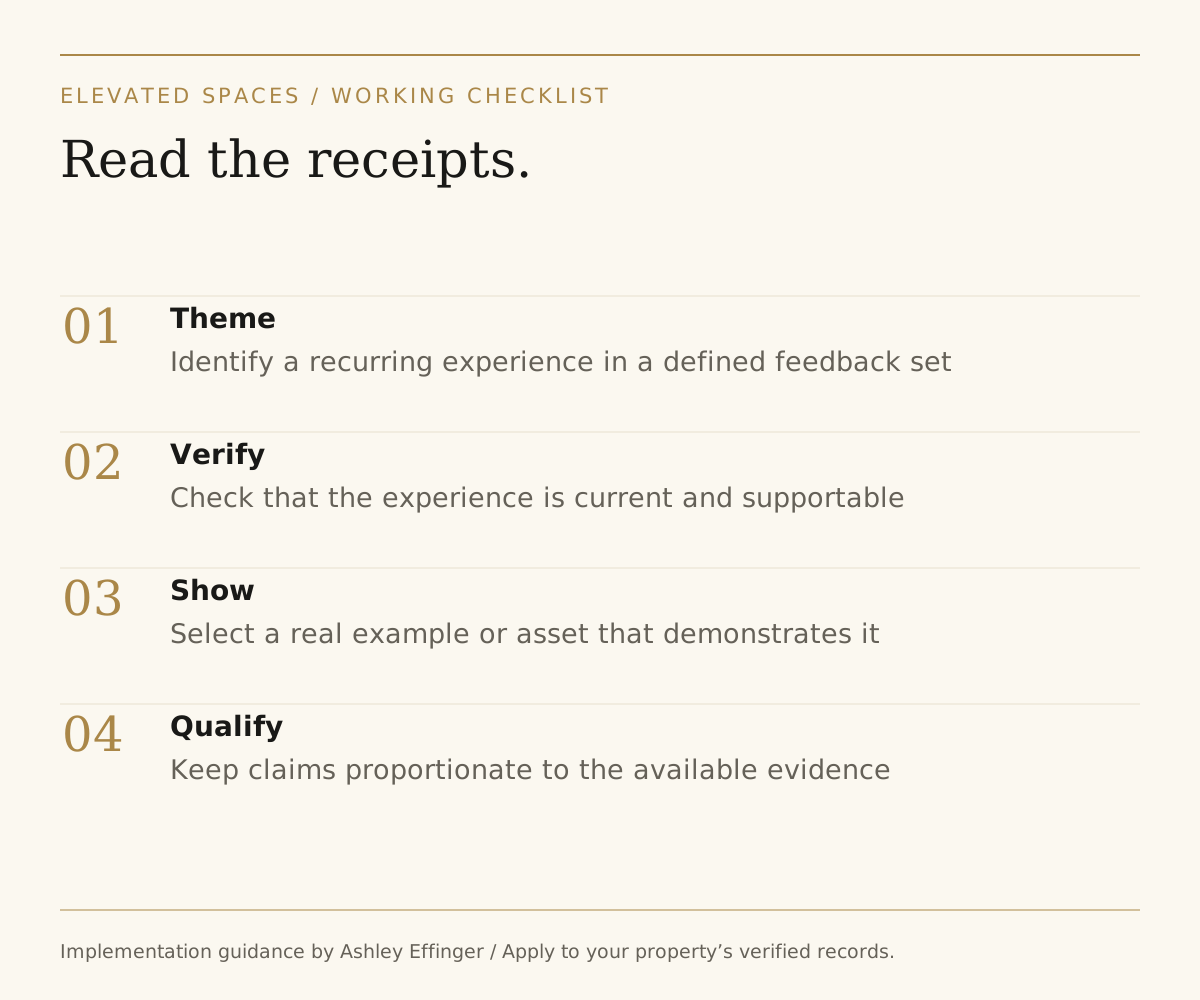
Read the framework as text
Practical review checklist. Theme: Identify a recurring experience in a defined feedback set. Verify: Check that the experience is current and supportable. Show: Select a real example or asset that demonstrates it. Qualify: Keep claims proportionate to the available evidence.
Turn the evidence into a useful asset
Choose the format that best demonstrates the verified experience. Clear arrival guidance could become a short process preview. A shared workspace could benefit from photographs showing outlets, seating and access information.
The objective is to help a prospect understand something they will actually encounter. Repeating “our residents love it” asks the audience to accept a conclusion without seeing the reason.
If you want to republish a review or quote, verify permission, usage requirements and accuracy through the appropriate process. Preserve the meaning and context; do not assemble fragments into an endorsement the resident never made.
You can also explain the feature in your own words and show the underlying service. An observation about what readers value does not require turning every resident into a testimonial.
Keep the proof current
Add a review date to the claim inventory. A praised feature may change, a process may be revised and a contact arrangement may become outdated. Marketing should have a route for learning when the supporting experience changes.
Track the claims, their evidence and the assets that use them. That lets the team update the right pages and campaigns rather than discovering an old promise after a prospect asks about it.
The 60-Second Luxury Audit Toolkit provides a starting point for examining whether the experience supports the language. Bring the feedback inventory into that review, alongside current observations and operating information.
The best line may already be hiding in what residents repeatedly notice. Your job is to find it, verify it and explain it with enough specificity to mean something.
Multifamily Content Vault
Turn useful property questions into content with evidence, a clear purpose and a next step.
Get the Content VaultMultifamily Renewal Experience Planner
Review promises, own issue updates and prepare renewal conversations with verified information.
Get the Renewal Experience PlannerPut the perspective to work.
Explore positioning, marketing performance and experience strategy for luxury multifamily and Class A commercial properties.
Work with Ashley