

A list of uses is not the whole story
Live. Work. Shop. Dine.
Those words tell the reader what is present. They leave the relationship among the parts largely unexplained.
Mixed-use marketing becomes more useful when it helps someone understand an actual journey. Where would they enter? What is accessible from where? Which services are open when they need them? What conditions affect the connection?
The answer may differ for a resident, an office tenant, a retailer and a visitor. A unified property identity can support those distinct needs without pretending everyone experiences the place in the same way.
Start with a route that matters and verify it.
Choose one journey to inspect
An illustrative resident journey could involve walking from a residential entrance to an open retailer. An office visitor might need to move from parking to a meeting and then find a place to eat.
Walk the actual route using the information the public receives. Record entrances, signs, crossings, operating hours and any access conditions. Confirm details with the responsible teams.
The presence of a business nearby does not establish that it is reachable by the route someone expects or open at the relevant time. Marketing should not leave those assumptions hidden inside “everything at your doorstep.”
Where a condition changes by day or time, explain how visitors can find current information. A useful connection includes a reliable way to check it.
Turn adjacency into a practical explanation
A map can show what is near what. It becomes more useful when it also clarifies the relevant entry, route and destination.
Pair it with photographs from recognizable points along the journey. Use accurate labels and avoid presenting an illustrative map as a precise survey or a promise about travel time.
Explain the benefit in plain language: a specific route to a confirmed service, a clear connection between entrances or a practical option for visitors between appointments.
The value of a connected place becomes clearer when people can picture how they would move through it.
Keep the explanation grounded. A nearby restaurant may support a visit occasion without proving increased sales for every retailer or improved productivity for every office tenant.
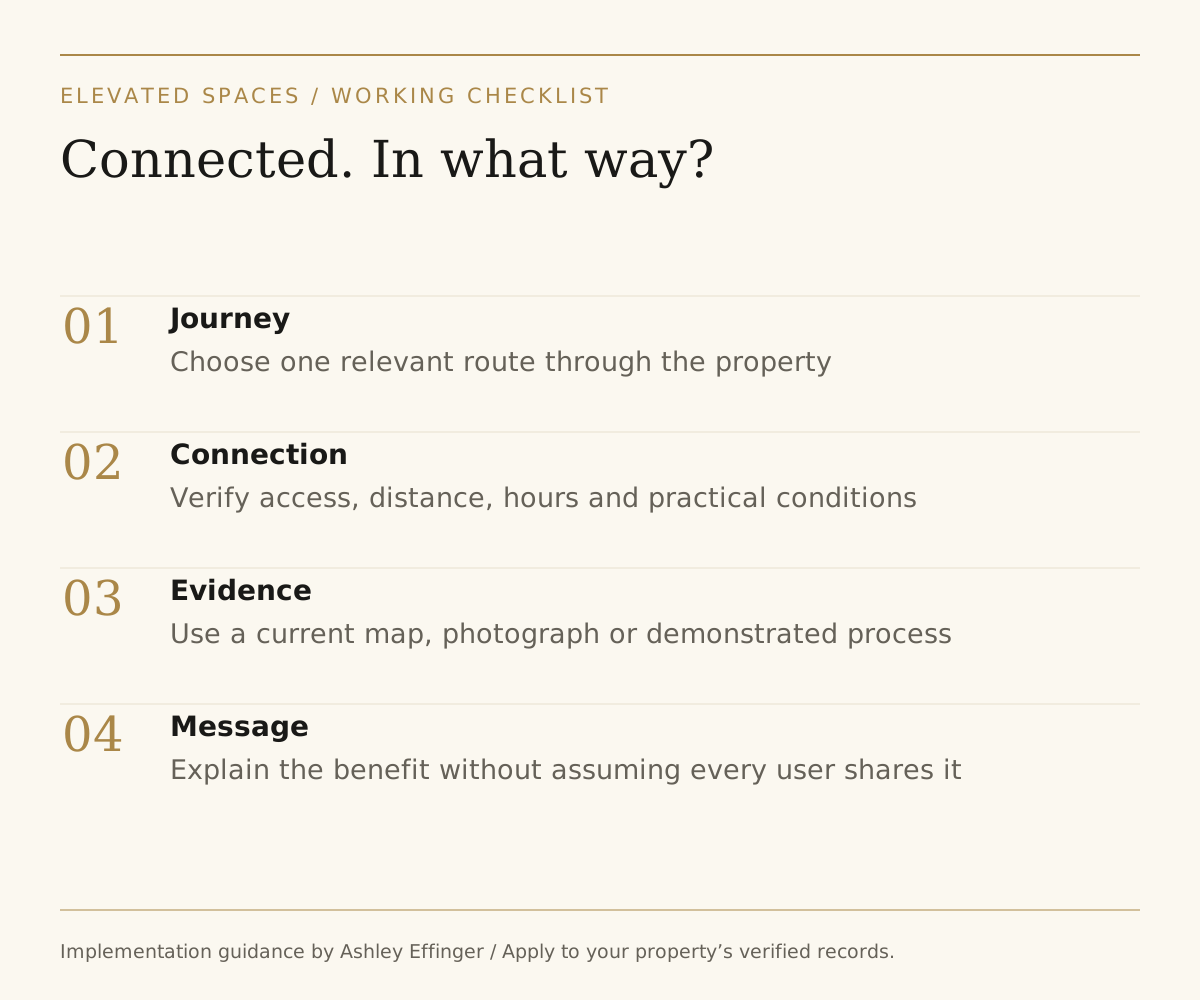
Read the framework as text
Practical review checklist. Journey: Choose one relevant route through the property. Connection: Verify access, distance, hours and practical conditions. Evidence: Use a current map, photograph or demonstrated process. Message: Explain the benefit without assuming every user shares it.
Coordinate the information behind the brand
A mixed-use property may have different teams maintaining residential, commercial and visitor information. Identify who confirms each fact and how changes reach the shared marketing.
Create a small central record for entrances, public-facing businesses, operating information and recurring visitor questions. Keep links to the authoritative source where details change frequently.
Agree on how new openings, closures or access changes appear across the website, newsletters and social channels. A coordinated identity loses usefulness when one part of the site describes a different operating reality from another.
Give each audience a clear next step. A resident exploring services should not be forced through a leasing form, and an office prospect should be able to reach the commercial team directly.
Assess understanding before claiming impact
Ask someone unfamiliar with the property to follow the information and describe the route. Note where they hesitate, which labels are unclear and what they assumed incorrectly.
Use those observations to improve the map, captions or navigation. They can identify usability problems without establishing how the changes affect occupancy or tenant revenue.
Track relevant inquiries and recurring questions after publication. Bring the findings to both marketing and operations, because a confusing route may need a physical improvement as well as a better explanation.
The CRE Property Positioning Toolkit is available now to help organize the verified connections, supporting evidence and messages.
Mixed-use marketing has an opportunity to make the whole property understandable. The strongest story is one the person can follow on the ground.
Tenant Experience & Engagement Planner
Organize useful tenant communications, purposeful events, accountable feedback and evidence-based reviews.
Get the Tenant Experience PlannerProperty Photography & Content Brief Builder
Turn prospect questions into purposeful shot lists, clear creative briefs and organized asset handoffs.
Get the Brief Builder