

Listen while there is still time to act
A resident has asked three times how to reserve a space. Another cannot get a clear update on a request. Marketing is preparing a renewal message about exceptional living.
There may be a slight gap in the conversation.
Retention work begins long before the renewal email. It begins in the effort residents spend trying to use the experience they are already paying for.
The listening loop turns those everyday signals into ownership, correction and follow-through. A survey without that loop is an inbox with better branding.
Create a listening loop with a narrow purpose. Select one experience the team can influence, such as understanding amenity access or finding the correct service information.
Use the property’s existing feedback channels rather than launching another survey without a plan for the answers.
Define who reviews the feedback and how often. Without an owner, a collection of comments can become a growing archive of unresolved issues.
The first useful outcome is a reliable way to distinguish an individual request, a recurring communication gap and a broader operating concern.
This process supports retention work without assuming every departure can be prevented or every complaint reflects the same cause. Residents make housing decisions for many reasons.
The team can still improve the clarity and consistency of experiences within its control.
Record the pattern before writing the conclusion
Silence is not a satisfaction score. Distinguish direct feedback from the story the team tells about it. Repeated confusion about a process deserves investigation even when nobody uses the word complaint.
Separate direct feedback from interpretation. “Several residents asked where to find reservation instructions” is a useful pattern.
“Residents do not appreciate the amenities” is a conclusion that may not follow. The distinction helps the team choose a response that addresses the observed problem.
Look across communication and operations. A repeated question might require clearer instructions, but it might also indicate that the process itself is unnecessarily complicated.
Rewriting the explanation should not become a permanent substitute for fixing an avoidable operating obstacle.
Keep the scope manageable. Review a small set of recurring themes and identify what evidence is missing.
The aim is a practical learning habit, not a claim that the team can quantify every aspect of satisfaction from informal comments.
A resident should not have to become a project manager to receive the promised experience.
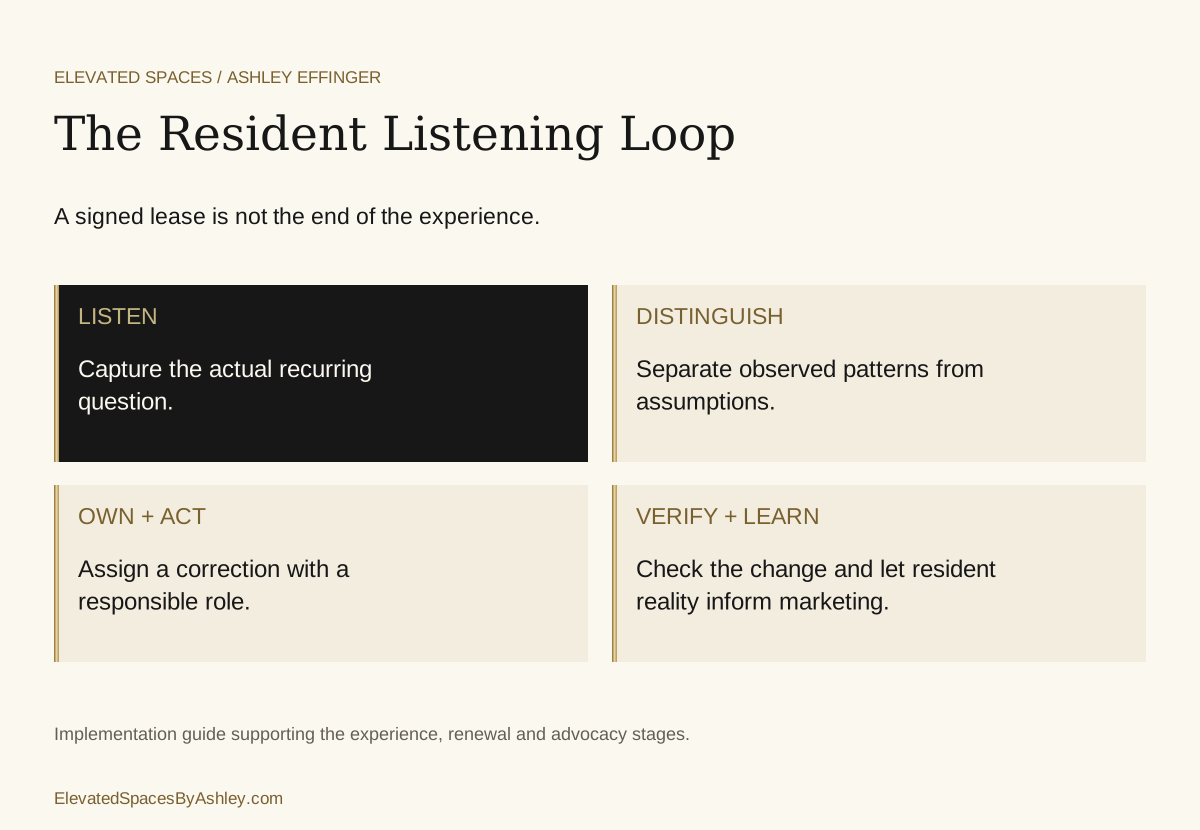
Read the framework as text
The Resident Listening Loop. LISTEN: Capture the actual recurring question.. DISTINGUISH: Separate observed patterns from assumptions.. OWN + ACT: Assign a correction with a responsible role.. VERIFY + LEARN: Check the change and let resident reality inform marketing.
Make the response visible through a real change
A listening loop closes only when somebody owns the next action and verifies the result. “We shared the feedback” is a handoff, not a resolution.
Communicate completed improvements through appropriate resident channels. Explain the actual change and where to find current information.
Avoid turning a routine correction into an exaggerated brand story. Clear, factual follow-through can be more useful than celebratory language.
For an illustrative example, repeated confusion about a shared-space booking process could lead to one authoritative instruction page and updated move-in materials. The team would then review whether the same question continues to arise and whether the process itself needs another adjustment.
If an issue cannot be resolved quickly, communicate what is known through the property’s normal service process. A listening loop loses value when it collects feedback but gives residents no accurate indication of what happens next.
Let resident reality correct the marketing
Acquisition content should learn from lived experience. If residents repeatedly need a qualification your campaign omits, the copy needs a conversation with operations. The premium has to survive move-in.
Keep promotional claims aligned with the experience currently delivered. Do not use an improvement that is merely planned as proof of a completed change.
A shared record between marketing and operations helps preserve that distinction as content is produced and reused.
Review the loop periodically: which issues were identified, which actions were completed and which questions remain open? Do not interpret a decline in comments as proof that satisfaction improved without considering how feedback was collected.
The process should support learning rather than decorate a report.
The Multifamily Leakage Map focuses on handoffs across the prospect journey. The Multifamily Renewal Experience Planner brings promise reviews, issue updates and communication records into the resident conversation. The same discipline applies: a question needs an owner, an action and closure.
Begin the resident loop before the renewal calendar becomes a deadline, while there is time to make useful changes.
Multifamily Marketing KPI Dictionary
Agree on what the metric counts before interpreting the result or deciding the next action.
Get the KPI DictionaryMultifamily Content Vault
Turn useful property questions into content with evidence, a clear purpose and a next step.
Get the Content VaultMultifamily Renewal Experience Planner
Review promises, own issue updates and prepare renewal conversations with verified information.
Get the Renewal Experience PlannerRelated published work
Continue with Ashley’s original articles. This website companion focuses on practical implementation.
- Your Best Amenity May Already Be Built: A New Way to Measure Amenity Performance · Multifamily Insiders
- The Next Multifamily Growth Strategy May Be Retention, Not Acquisition · Elevated Spaces on LinkedIn