

The notice cannot carry the entire relationship
A renewal notice can communicate an offer. It cannot retroactively repair months of unanswered questions.
By the time the notice arrives, a resident has already experienced maintenance communication, shared spaces, package collection, parking and the everyday accessibility of the team. Some moments may have been excellent. Others may still feel unfinished.
That history deserves attention before the team writes a more persuasive renewal email. The useful question is not “How do we make this sound warmer?” It is “What does the resident need to understand, and what have we left unresolved?”
This is a preparation method for a better conversation. It is not a formula that predicts whether a particular resident will renew.
Review the experience without inventing a score
Use the service and communication records your organization already maintains. Identify open items, repeated concerns and commitments awaiting confirmation. Do not turn a casual impression into a label about a resident’s likelihood to stay.
For example, a resident may have reported the same access problem twice. Both work orders may show completion, while the explanation of the fix never reached the resident. The next action is to confirm the current condition and communicate clearly.
It would be a mistake to interpret that record as proof the person is leaving, or to assume another promotional email solves it.
Review trends at the property level as well. A recurring question about shared-space access may need a community-wide clarification, alongside any individual response.
Give unresolved issues a separate route
Keep service resolution and renewal terms distinct. The resident should know how an issue will be handled regardless of the decision about another lease.
Assign an owner and an update date. Confirm what has been completed, what remains open and who can answer questions. If the team cannot complete an action immediately, explain the current status accurately.
An illustrative working entry could read: “Access issue reviewed with the responsible team; instructions clarified; resident invited to report whether the problem recurs; follow-up due Friday.” That provides more useful direction than “retention risk.”
Preparation means knowing what you owe the conversation before you ask for a decision.
Keep the documentation factual and relevant. Avoid assumptions about personal circumstances, household characteristics or reasons a resident has not volunteered.
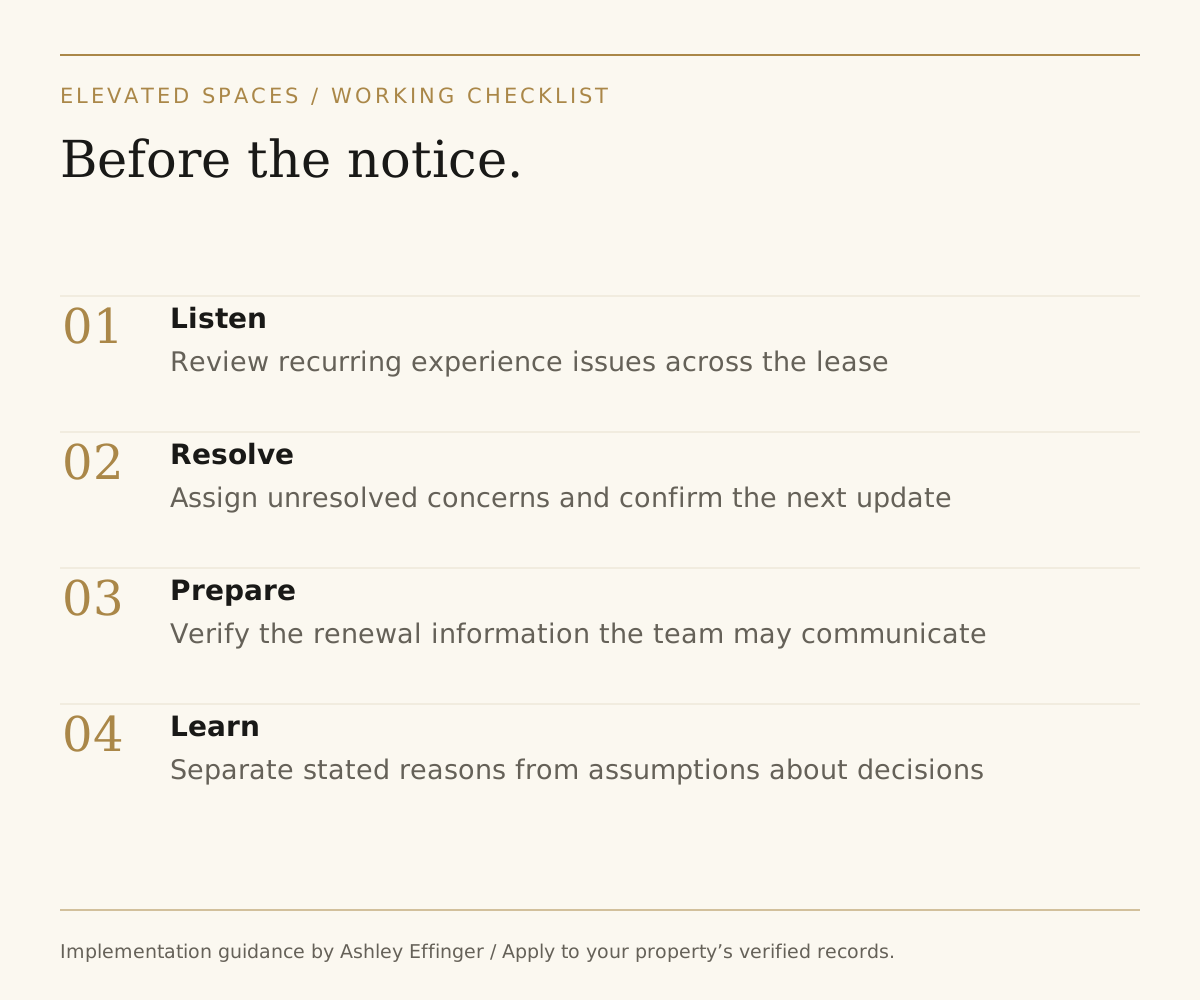
Read the framework as text
Practical review checklist. Listen: Review recurring experience issues across the lease. Resolve: Assign unresolved concerns and confirm the next update. Prepare: Verify the renewal information the team may communicate. Learn: Separate stated reasons from assumptions about decisions.
Make the renewal information usable
Once authorized terms are available, review the message from the resident’s perspective. Is the deadline clear? Is the response process obvious? Can the resident identify the right contact for questions?
Check that property staff and marketing are working from the same approved information. A polished email can create unnecessary confusion if the team has different dates or cannot explain the next step.
Use reminders thoughtfully and consistently with the organization’s process. The purpose is to help someone understand an available decision, not to make an unanswered message feel like an emergency.
Keep a record of recurring questions. If several residents misunderstand the same instruction, revise the communication. Repetition is evidence that the process deserves inspection before the team blames attention spans.
Learn from the reasons people actually give
When a resident chooses to leave, invite feedback through an appropriate process. Preserve the distinction between a stated reason, an observed condition and an internal interpretation.
“Relocating for work” is a reported reason. “Probably unhappy with amenities” is a hypothesis unless the resident said so. Combining the two will produce a misleading picture of the experience.
Review patterns over a defined period and explain whose feedback is represented. The people who respond may differ from those who do not. Use the findings to prioritize questions and improvements, not to claim certainty about every departure.
The Multifamily Renewal Experience Planner is available now to organize promise reviews, unresolved issues and preparation for the next conversation. A useful renewal conversation starts with a team that has done its homework.
Multifamily Content Vault
Turn useful property questions into content with evidence, a clear purpose and a next step.
Get the Content Vault