

The photo is an output
The room was full. The table looked beautiful. The recap is ready for Instagram.
Those are useful observations about an event. They do not tell us whether it addressed the reason the team held it.
A welcome gathering, an introduction to an underused space and an opportunity to hear resident questions are different assignments. They should influence the invitation, timing, staffing and follow-up in different ways.
Before choosing the catering, finish this sentence: “We are hosting this because residents need an easier way to…” If the answer is only “engage,” keep working. A broad aspiration is difficult to design around and even harder to evaluate.
Choose a purpose the team can observe
Consider an illustrative property with a shared work lounge that receives repeated access questions. A small hosted introduction might help residents understand where to enter, when the space is available and which activities it supports.
The objective would be to clarify use, not to prove the room is popular. Relevant observations might include the questions asked, the instructions residents find confusing and whether the team needs better signage.
A different event might introduce residents to local businesses or give people a low-pressure opportunity to meet neighbors. Define a purpose that fits the community and its actual operating capacity.
Do not attach a promised retention result to an event simply because retention matters to the business. The evaluation should match what the activity can reasonably reveal.
Design around access and practical details
Ask who can participate at the proposed time and what options exist for people who cannot. One turnout figure does not tell you whether the format worked for the wider community.
Review the route, seating, instructions and available information. Make participation optional and communicate clearly. A resident should not have to attend a social gathering to learn essential property information.
For the lounge introduction, the team could provide the same practical guidance afterward through an accessible communication channel. That helps residents who missed the event and gives staff a consistent reference.
The event is one way to deliver the experience. The experience should not depend entirely on attending it.
Brief everyone supporting the activity. They should know the purpose, the questions to record and the person responsible for follow-up.
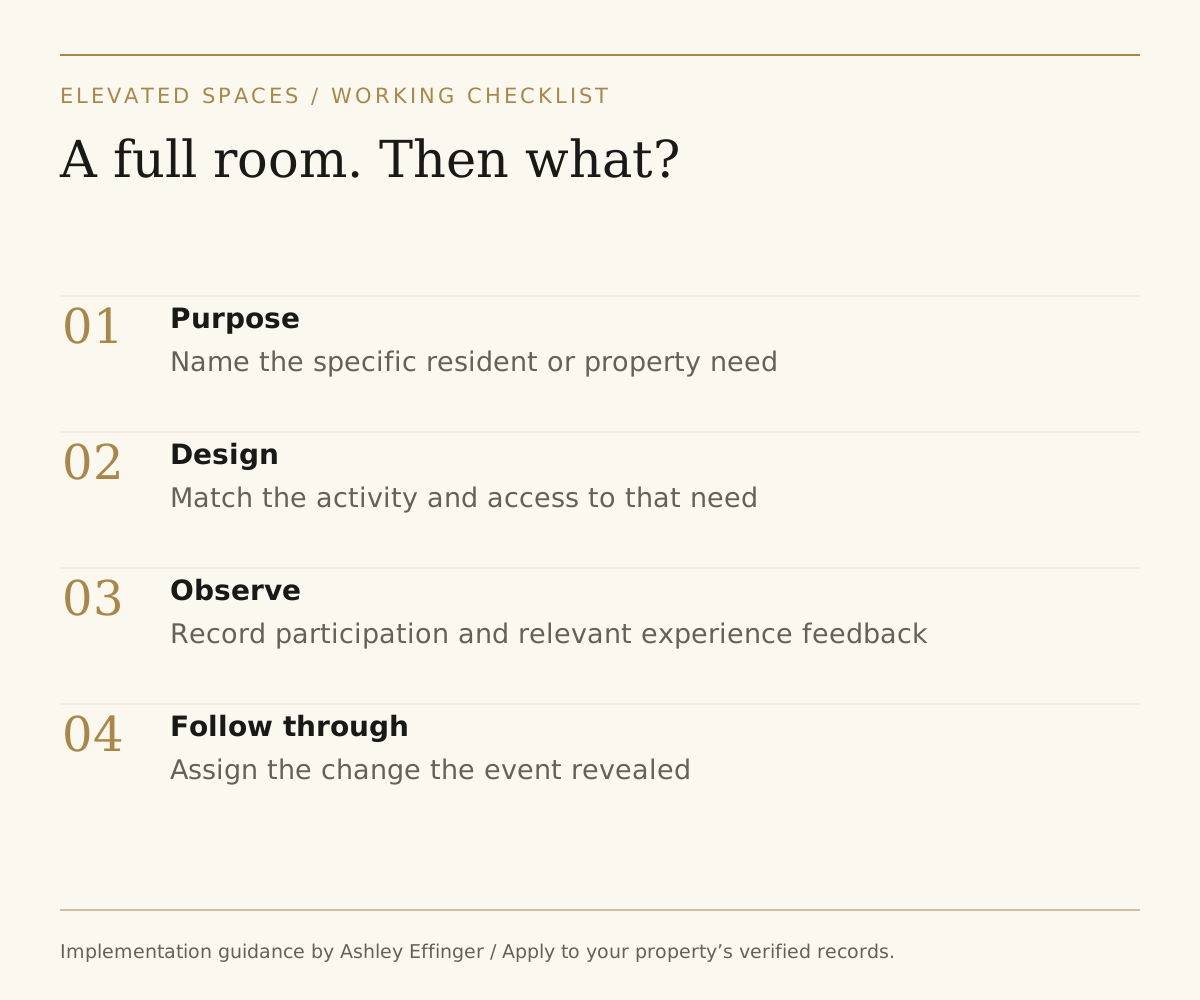
Read the framework as text
Practical review checklist. Purpose: Name the specific resident or property need. Design: Match the activity and access to that need. Observe: Record participation and relevant experience feedback. Follow through: Assign the change the event revealed.
Measure the experience you designed
Record attendance, but explain the measure. Does it count unique participants, household registrations or check-ins? An estimate from a photograph is different from a sign-in record.
Pair that figure with relevant observations. For an orientation, note which instructions required explanation. For a feedback session, record themes and the number of respondents without treating the sample as every resident’s opinion.
Consider the resources used: staff time, direct costs and any changes to normal operations. A smaller event that provides clear answers may be more useful than a larger activity that leaves the original problem untouched.
Keep interpretation proportionate. Attendance and positive comments can describe the event. They cannot, on their own, demonstrate that it caused renewals or improved the community’s overall satisfaction.
Make the follow-through part of the budget
Set aside time after the event to close the loop. If residents repeatedly ask about booking the lounge, someone should review the booking instructions. If a promised answer is pending, assign it and communicate the update.
The recap can show something more useful than a crowd. Explain what residents learned, which resources are now easier to find or what the team will address next. Use images with appropriate permission and avoid presenting attendance as an endorsement from everyone pictured.
Amenity Activation Score™ can help structure observations about the space before and after an activity. Use the findings to decide whether the next step is another event, a practical operating change or clearer communication.
A successful event should leave the team with more than leftover cupcakes and a caption.
Tenant Experience & Engagement Planner
Organize useful tenant communications, purposeful events, accountable feedback and evidence-based reviews.
Get the Tenant Experience Planner