

A room is an asset. A routine is an experience.
Another rooftop photograph. Another caption about elevated living. Another resident who does not know how to book the room downstairs.
The amenity is visible. Its usefulness is still waiting for instructions.
This is the distinction behind my Amenity Activation Score™. Presence is only the beginning. A space creates a stronger value story when people can discover it, access it, use it and find a reason to return.
Before commissioning another amenity post, examine the operating story the photograph cannot tell.
That story connects the physical feature to its actual use. It explains how someone discovers the amenity, understands its purpose, gains access and receives help if something does not work.
Marketing and operations both have a role in making that sequence coherent.
Choose one amenity rather than reviewing the entire property at once. Walk through its current process with the person responsible for it.
Record the ordinary conditions, not the ideal scenario described when the space first opened. A change in hours or access arrangements can make older content inaccurate.
This is a useful starting point before another promotional post because the review may reveal a simpler need: clearer instructions, more accurate photography or a better explanation during the tour. More attention helps only when the experience is ready to be understood.
Explain how the experience actually works
Map discovery, access, use and follow-through. Name the owner of each fact. An instruction that exists only in somebody’s memory is not a reliable service system.
Separate the public explanation from internal procedures. The customer-facing version should be clear enough to support a decision.
The internal version may include maintenance ownership, escalation and temporary closure communication. Confusing the two can either overload the marketing or omit information staff need.
Look for places where a person must rely on informal knowledge. A room may be reservable, but the booking method may be mentioned only during move-in.
A visitor may see a compelling photograph without learning that access varies. Those are information gaps with specific remedies.
For an illustrative case, a shared workspace could have an excellent setting but unclear reservation rules. The first improvement would be a verified access explanation in the places people look for it.
A more dramatic photograph would leave the underlying question unresolved.
Your best next amenity may need better activation before it needs a bigger budget.
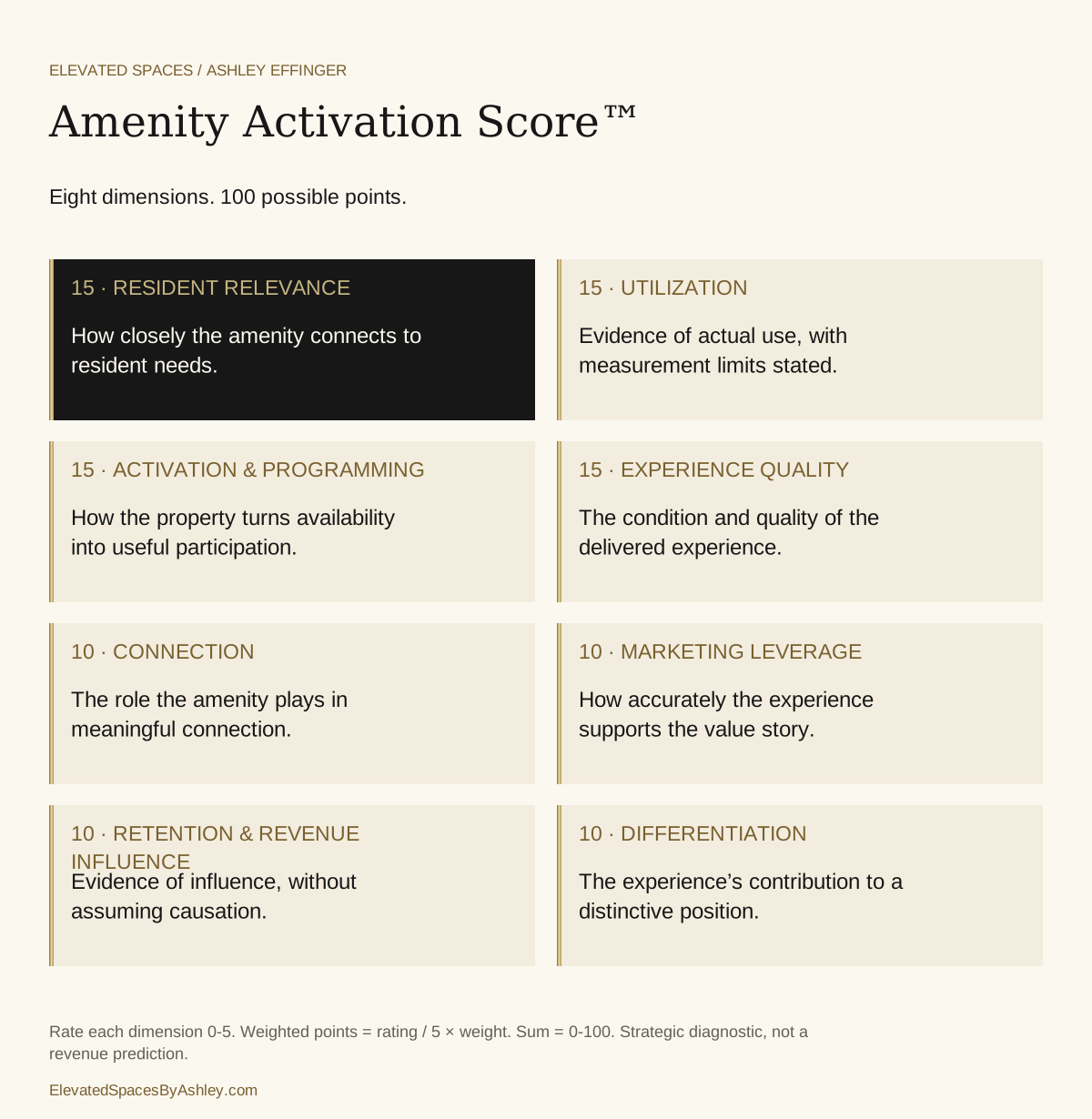
Read the framework as text
Amenity Activation Score™. 15 · RESIDENT RELEVANCE: How closely the amenity connects to resident needs.. 15 · UTILIZATION: Evidence of actual use, with measurement limits stated.. 15 · ACTIVATION & PROGRAMMING: How the property turns availability into useful participation.. 15 · EXPERIENCE QUALITY: The condition and quality of the delivered experience.. 10 · CONNECTION: The role the amenity plays in meaningful connection.. 10 · MARKETING LEVERAGE: How accurately the experience supports the value story.. 10 · RETENTION & REVENUE INFLUENCE: Evidence of influence, without assuming causation.. 10 · DIFFERENTIATION: The experience’s contribution to a distinctive position.
Give the content something real to demonstrate
Show the verified routine. Explain the practical use and the conditions around it. Avoid promising that a room will manufacture community, productivity or belonging simply because the furniture photographs well.
Avoid promising that the amenity produces a particular social or professional outcome. A room can offer a setting and certain facilities.
It cannot guarantee friendship, productivity or belonging. Let the content communicate what is available while people evaluate the benefit for themselves.
Use a sequence where one photograph is insufficient. A short walkthrough, an instruction card and a useful answer to a recurring question can work together.
Choose formats based on the explanation required, rather than treating every amenity as another lifestyle carousel.
Ask the operating owner to review the final asset before publication. They can identify a restriction, temporary condition or wording that marketing might miss.
Keep a review date with the asset so the explanation remains accurate after the campaign ends.
Use the Activation Score to choose the work
The Amenity Activation Score™ evaluates eight weighted dimensions. It is a diagnostic for deciding where to investigate and improve, not a validated prediction of revenue. A low-scoring dimension needs evidence and an action, not a more flattering caption.
If the property tracks amenity use, establish how that information is collected and what it can reasonably show. A booking record does not necessarily capture every form of use.
A quiet period may reflect awareness, access, competing needs or other conditions. Treat interpretation as a question to investigate.
Do not launch an activation campaign before checking the space’s readiness and capacity. Increased attention can expose an unresolved operating problem.
Coordinate communication with the people who will deliver the experience and handle the questions it creates.
The planned Amenity Activation Score will organize this review. Begin with one verified operating story and one communication improvement.
An amenity becomes easier to market when the team can explain its real use with the same confidence it brings to its appearance.
Multifamily Content Vault
Turn useful property questions into content with evidence, a clear purpose and a next step.
Get the Content VaultRelated published work
Continue with Ashley’s original articles. This website companion focuses on practical implementation.
- Your Best Amenity May Already Be Built: A New Way to Measure Amenity Performance · Multifamily Insiders
- Stop Posting Amenities: Build a Content World Renters Want to Enter · Multifamily Insiders