
Find the unfinished decision
“Just checking in.”
The four words that announce the sender would like a response while giving the recipient remarkably little to respond to.
After a tour, a prospect may be comparing layouts, verifying timing or waiting for an answer you promised. A generic nudge makes all of those situations sound the same.
Useful follow-up completes the conversation. It remembers the actual question, supplies a verified answer and makes the next step worth taking.
The host can capture that context in a short note: the relevant home, what the visitor wanted to understand, the answer already provided and anything promised afterward. This is enough to make the next message specific without collecting unnecessary personal detail.
If the prospect did not identify an open question, do not invent one. Offer accurate information discussed during the visit and a clear way to ask for clarification.
A useful follow-up respects the possibility that the visitor is still comparing options or has decided the home does not fit.
The objective is a better decision process. A message can be valuable even when the eventual answer is no, because the property has explained its offering clearly and avoided making the prospect work to obtain basic information.
Write the answer before the nudge
A specific plan, current fact or relevant comparison does more work than another reminder that the property exists. The prospect remembers the tour. Help them understand what they still need to decide.
For an illustrative example, the visitor asked whether a desk would fit without obstructing the living area. A useful message would link to an accurate dimensioned plan, identify the relevant space and offer a chance to revisit the layout if needed.
It would avoid guaranteeing that a particular piece of furniture fits unless the team can substantiate that claim.
If an answer requires another colleague, name the responsibility and the communication plan. Do not substitute a vague assurance for information the team has not checked.
A credible pending answer can preserve clarity better than a confident guess.
Use the channel and contact permissions already established through the property’s process. Keep the tone professional and helpful.
The message should feel connected to the visit, rather than like a generic sequence triggered by the passage of a day.
Follow-up should contribute something the prospect did not already have.
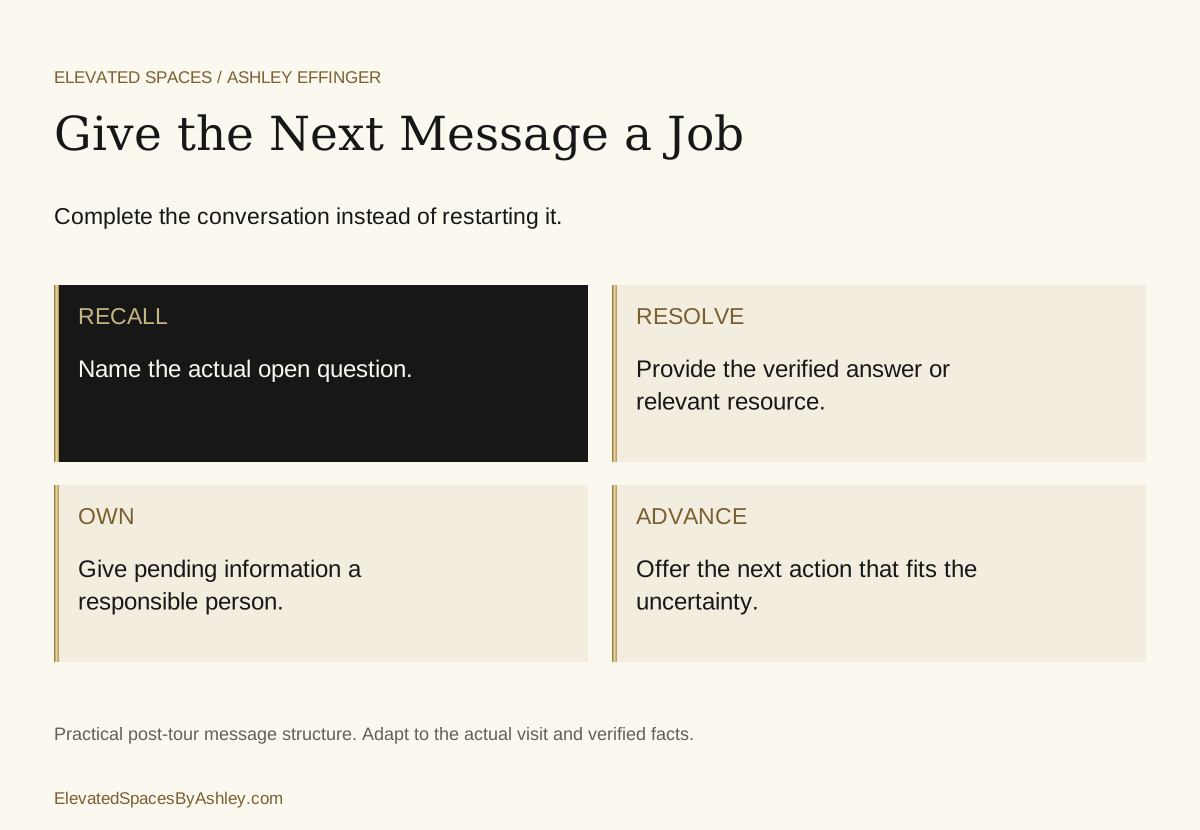
Read the framework as text
Give the Next Message a Job. RECALL: Name the actual open question.. RESOLVE: Provide the verified answer or relevant resource.. OWN: Give pending information a responsible person.. ADVANCE: Offer the next action that fits the uncertainty.
Offer the next useful step
Not every uncertainty is solved by “apply now.” Sometimes the useful step is a clearer comparison or another look at the right feature. Ask for the action that fits the question.
Do not treat every response as a reason to push immediately toward an application. If the person lacks essential information, resolve that before asking them to commit.
A well-timed invitation is more useful when it follows an informed conversation.
Avoid manufactured urgency. Where an actual availability condition matters, communicate it accurately and make clear that it can change.
Keep offer language aligned with the property’s approved terms. Follow-up is part of the marketing experience and deserves the same factual care as the advertisement.
Ask staff to review whether the recipient can act without replying merely to request a missing link, date or document. Removing those small gaps is an achievable improvement that can make the conversation easier for both sides.
Audit relevance before adding frequency
Before adding a seventh touch, inspect the first six. If a colleague cannot tell which visit produced the message, the missing ingredient may be context rather than cadence.
Track the questions that remain unresolved and the reasons answers are delayed. Those observations can improve the underlying website, tour materials and internal handoffs.
Follow-up should not permanently compensate for information the property could explain clearly earlier.
Treat response patterns as feedback rather than proof that a particular wording caused a lease. Availability, pricing, timing and fit all affect the result.
A practical review can establish whether the communication was accurate, relevant and completed as promised.
The Tour Readiness Checklist includes a follow-through record and adaptable message structures. Use those as starting points, then write from the actual conversation.
The strongest follow-up is often the one that completes a useful promise the host made during the visit.
Tour Readiness Checklist
Bring the digital promise and onsite experience together.
Get the toolkitMultifamily Marketing KPI Dictionary
Agree on what the metric counts before interpreting the result or deciding the next action.
Get the KPI DictionaryRelated published work
Continue with Ashley’s original articles. This website companion focuses on practical implementation.
- The Tour Starts Before the Tour: Designing a High-Intent Prospect Journey · Multifamily Insiders
- The CRE Retargeting Blueprint: How to Stay Top-of-Mind Without Looking Desperate · Elevated Spaces on LinkedIn