
Rehearse the ordinary day
The pillows are straight. The lights are on. The model smells expensive.
Meanwhile, the prospect has parked at the wrong entrance, the backup host has not seen the inquiry, and the amenity that did the selling online is locked.
Technically, the apartment is ready. The experience is still getting dressed.
This is why I like a tour rehearsal. A checklist can confirm that something exists. A rehearsal reveals whether the connections work when a person actually tries to use them.
Set aside twenty focused minutes. Give one colleague the role of visitor and another the role of host.
Use a fictional inquiry grounded in a real available floor plan. Choose practical requirements such as a move date, a layout question and a need to understand parking.
Avoid inventing demographic profiles to decide who belongs at the property.
Send the same appointment details your team currently uses. Ask the visitor to begin at the normal arrival point.
The host should use the regular process and current tools. Do not fix every small issue in advance; the purpose is to observe where ordinary preparation holds up and where the team has to improvise.
Keep this a process exercise. The goal is to improve the conditions under which staff work, rather than catch a colleague making a mistake.
That distinction changes the honesty and usefulness of the discussion afterward.
Start where the visitor starts
Arrival is not a warm-up act. It is the first physical test of the promise. If the campaign sold ease, a confusing entry sequence has already started arguing with it.
At the greeting, notice whether the host can identify the purpose of the visit without making the visitor repeat the full inquiry. A clear handoff can be as simple as a useful appointment note and a named backup.
It does not require memorizing every detail about someone before meeting them.
Record the first point of avoidable uncertainty exactly as it happened. “Arrival confusing” is less useful than “Confirmation names the leasing office, but the visitor enters from a different street and cannot see the office sign.” The second version suggests a correction that can be verified.
If the route creates an access or safety concern, treat that through the property’s established escalation process. A marketing rehearsal should never become an excuse to improvise around an unsafe or inaccessible route.
The model can be ready while the journey is not.
Read the framework as text
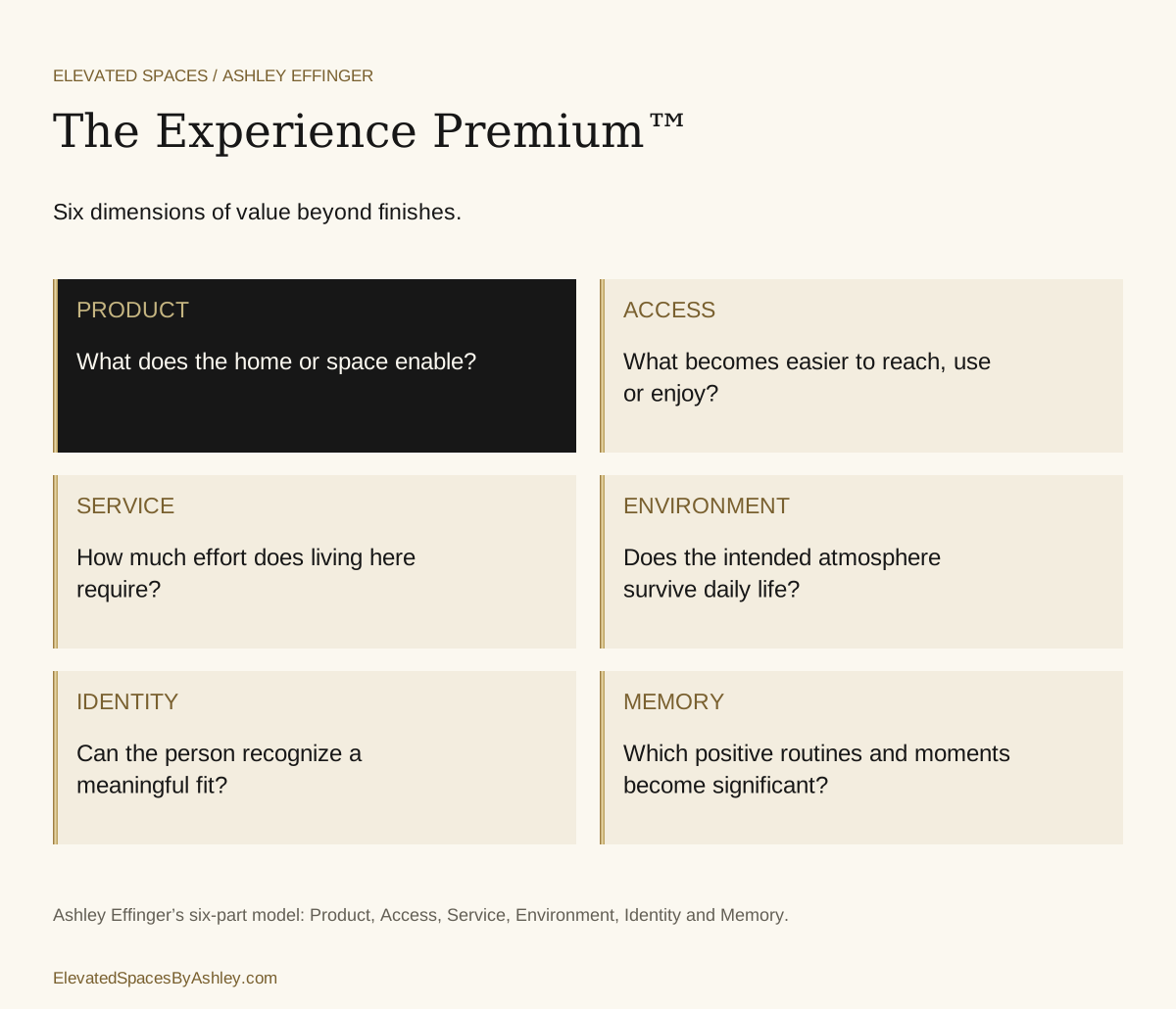
The Experience Premium™. PRODUCT: What does the home or space enable?. ACCESS: What becomes easier to reach, use or enjoy?. SERVICE: How much effort does living here require?. ENVIRONMENT: Does the intended atmosphere survive daily life?. IDENTITY: Can the person recognize a meaningful fit?. MEMORY: Which positive routines and moments become significant?
Practice the moment the plan breaks
An occupied shared room or an unanswered question is not automatically a failed tour. Bluffing your way through it is a poor recovery strategy. Practice an accurate alternative, a named owner and a credible plan for the answer.
Introduce one ordinary complication. The shared room is occupied, the intended route is temporarily unavailable, or the prospect asks something the host cannot confirm.
The host should practice an honest response: explain what is known, offer an accurate alternative and name who will supply the missing answer.
Do not invent a service guarantee to keep the conversation smooth. A prepared recovery sounds more confident when it has a real owner and a credible follow-up commitment.
The visitor should leave knowing what remains open and how it will be resolved.
Observe whether the host leaves room for evaluation. A tour is also a chance for the prospect to determine fit.
Rushing past an unanswered question may preserve the schedule while weakening the usefulness of the visit.
Fix the process before grading the person
A rehearsal should expose process debt. It should not become a surprise performance review for the leasing professional compensating for it. Fix the missing information, unclear coverage or unreliable route, then run the same journey again.
Review the follow-up message as part of the rehearsal. It should refer to the actual question, provide accurate supporting information and propose a relevant next action.
A generic thank-you leaves the most valuable part of the visit out of the conversation.
Repeat the rehearsal after the change, using a different colleague if possible. You are checking whether the process works for someone without the original team’s shared knowledge.
If the issue persists, revise the instruction or handoff rather than assuming the visitor should have understood it.
The Tour Readiness Checklist turns the exercise into a repeatable preflight, route review and follow-through record. Use it before a busy showing day or whenever a new colleague joins the rotation.
Twenty minutes is a working format, not a guarantee that every readiness issue can be resolved within it.
What should a leasing team verify before an apartment tour?
Verify the intended home's current showability, the prospect's original question, the appointment time and meeting point, parking and entrance instructions, accessibility arrangements, approved price or offer information, and the named host with backup coverage. A beautiful model cannot compensate for missing arrival details.
If any item is unconfirmed, record the gap, assign an owner and confirm the resolution before the appointment. The Tour Readiness Checklist provides the fillable preflight, route review and follow-through fields for that work.
Leasing Follow-Up Toolkit
Carry the leasing conversation forward with a relevant answer, a clear owner and a useful next step.
Get the Follow-Up ToolkitPut the perspective to work.
Explore positioning, marketing performance and experience strategy for luxury multifamily and Class A commercial properties.
Work with AshleyRelated published work
Continue with Ashley’s original articles. This website companion focuses on practical implementation.
- The Tour Starts Before the Tour: Designing a High-Intent Prospect Journey · Multifamily Insiders
- The Experience Premium™: What Actually Makes a Renter Pay More? · Elevated Spaces on LinkedIn