

What can we actually show this week?
The ads team reports clicks. Leasing reports traffic. Operations reports readiness. Everybody has an update. Nobody has a shared next move.
That is a reporting circle, not a working meeting.
The Monday huddle should connect what is available, what prospects are asking and what the team can change this week. If the discussion ends with “keep doing what we’re doing,” the room should at least be able to explain why.
Five questions can make that conversation considerably less ceremonial.
Question one is simple: which available homes need attention this week, and which are ready to show? Bring a current snapshot with the relevant floor plans, dates and constraints.
Identify who verifies changes so the group does not leave with a list that is already becoming outdated.
Question two follows naturally: what does the current marketing ask a prospect to expect from those homes? Open the actual landing pages and listings.
Compare the promise with the inventory in front of the team. Note discrepancies without turning the meeting into a live copy-editing session.
These questions make production priorities more concrete. The needed work might be a corrected image, a clearer comparison or an updated confirmation message.
A modest task tied to current availability can deserve attention before an ambitious campaign with no immediate operating connection.
What did prospects need us to explain?
Bring the actual question, stripped of private details. “People do not see the value” is a theory. “Three visitors asked whether this photographed room is the available layout” is something the team can investigate.
Look for questions that recur across interactions. They may reveal information that should be easier to find before an appointment.
They may also expose a mismatch between an advertisement and the experience the team can deliver. Do not assume every objection requires a new campaign.
Invite the staff member closest to the interaction to explain the context. A campaign dashboard rarely captures whether someone was comparing dates, checking a layout limitation or waiting for a specific answer.
That context helps the marketing team select the right communication task.
Keep personal prospect details out of general meeting notes. The group needs the decision question and the process gap, not a dossier on an individual.
Useful learning can be recorded without circulating sensitive information beyond the people who need it.
A useful meeting leaves behind a changed process, not just a fuller calendar.
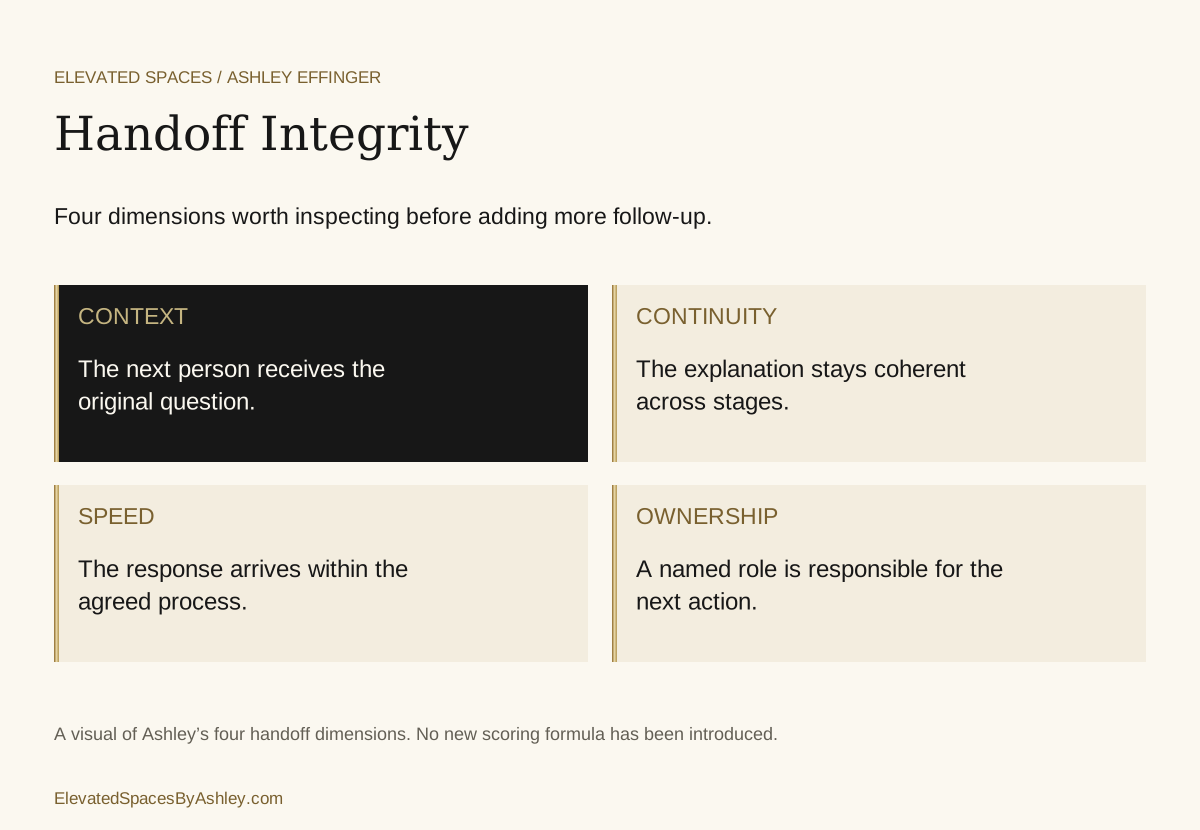
Read the framework as text
Handoff Integrity. CONTEXT: The next person receives the original question.. CONTINUITY: The explanation stays coherent across stages.. SPEED: The response arrives within the agreed process.. OWNERSHIP: A named role is responsible for the next action.
Where did the handoff lose the plot?
A prompt reply is good. A prompt reply that misses the question is merely fast confusion. Review context, continuity, speed and ownership before asking the team to send more messages.
Avoid making response speed the only discussion. A fast message can still fail to answer the question.
Review relevance, accuracy, ownership and the clarity of the proposed next action. Ask whether the person receiving the handoff had what they needed to move the conversation forward.
If the issue involves coverage, name a primary owner and a backup. If the issue involves missing facts, identify the person who can verify them.
If the issue involves conflicting instructions, choose one authoritative version and remove the outdated one.
An illustrative fix might be adding the prospect’s requested layout and unresolved question to the appointment note. That small change can spare the visitor a repeated explanation and help the host prepare.
It is specific enough to check at the next meeting.
What will be different by next Monday?
Choose a task with an owner, a due date and a way to verify completion. Then begin the next meeting with that task. Otherwise, the huddle becomes a weekly subscription to the same unresolved problem.
Limit the action list to what the team can reasonably complete. Larger issues can enter a separate backlog with a clear reason they are deferred.
The weekly meeting should create progress, rather than repeatedly reciting a list no one has capacity to resolve.
At the next huddle, begin with the previous action. Did the change happen?
Did it solve the observed problem? What remains uncertain?
This closes the loop between an interesting discussion and a better operating habit.
The upcoming Multifamily Marketing OS will provide a recurring place for this agenda and decision log. You can use the five questions immediately in a shared document.
The value comes from a current inventory picture, honest observations and a small number of accountable next steps.
Leasing Follow-Up Toolkit
Carry the leasing conversation forward with a relevant answer, a clear owner and a useful next step.
Get the Follow-Up ToolkitMultifamily Marketing KPI Dictionary
Agree on what the metric counts before interpreting the result or deciding the next action.
Get the KPI DictionaryRelated published work
Continue with Ashley’s original articles. This website companion focuses on practical implementation.
- PPC Clicks Don’t Lease Apartments. Alignment Does. · Elevated Spaces on LinkedIn