

Interrogate the headline
Ninety-six percent occupied. Lovely. Put it in the report.
Then ask what it took to get there.
How much concession support? How many inquiries that went nowhere? How many tours held together by a leasing professional performing operational gymnastics? How many renewals approaching with a value story that begins and ends at the pool?
A full building can coexist with a leaky process. Occupancy tells you a result at a point in time. It does not automatically tell you whether the way you achieved it is efficient, repeatable or resilient.
Confirm whether the report shows physical occupancy, leased occupancy or another internal definition. Record the date, inventory denominator and source.
Ask how notices, vacant ready units, preleases and unavailable units appear in the report. Consistent definitions make the next discussion more useful than a polished percentage alone.
The 96% in this article and its cover is illustrative. It is not an industry target, a client result or a signal that a property is healthy or unhealthy.
A similar headline could accompany very different situations, depending on inventory, lease expirations, pricing decisions and local conditions.
The marketing question is what decision the team needs to make next. That may be shifting attention to a particular floor plan, clarifying a recurring objection or preparing for upcoming availability.
First establish which question the current report can actually help answer.
Find the inventory hiding inside the average
A property-wide average is an excellent place for a stubborn floor plan to hide. Review availability by layout, readiness and timing. The next marketing move should respond to the inventory you need to explain, not the average you find easiest to present.
Use the same inventory snapshot across marketing, leasing and operations. Record which homes can be shown now, which photographs represent them accurately, and which advertised offers actually apply.
An appealing campaign for unavailable inventory can create activity without helping the property solve its immediate problem.
Next, examine the questions attached to the relevant homes. Are prospects unclear about dimensions, timing, total recurring costs, access arrangements or a layout feature?
Keep observed objections separate from staff assumptions. A reason recorded in a conversation is stronger evidence than a retrospective guess based on the final outcome.
This review can lead to a smaller and more useful marketing assignment. Instead of promoting the entire community again, the team might build an accurate comparison page for two layouts or replace a misleading hero photograph.
Specific inventory creates a clearer creative brief.
A healthy-looking headline can still have an unhealthy support system.
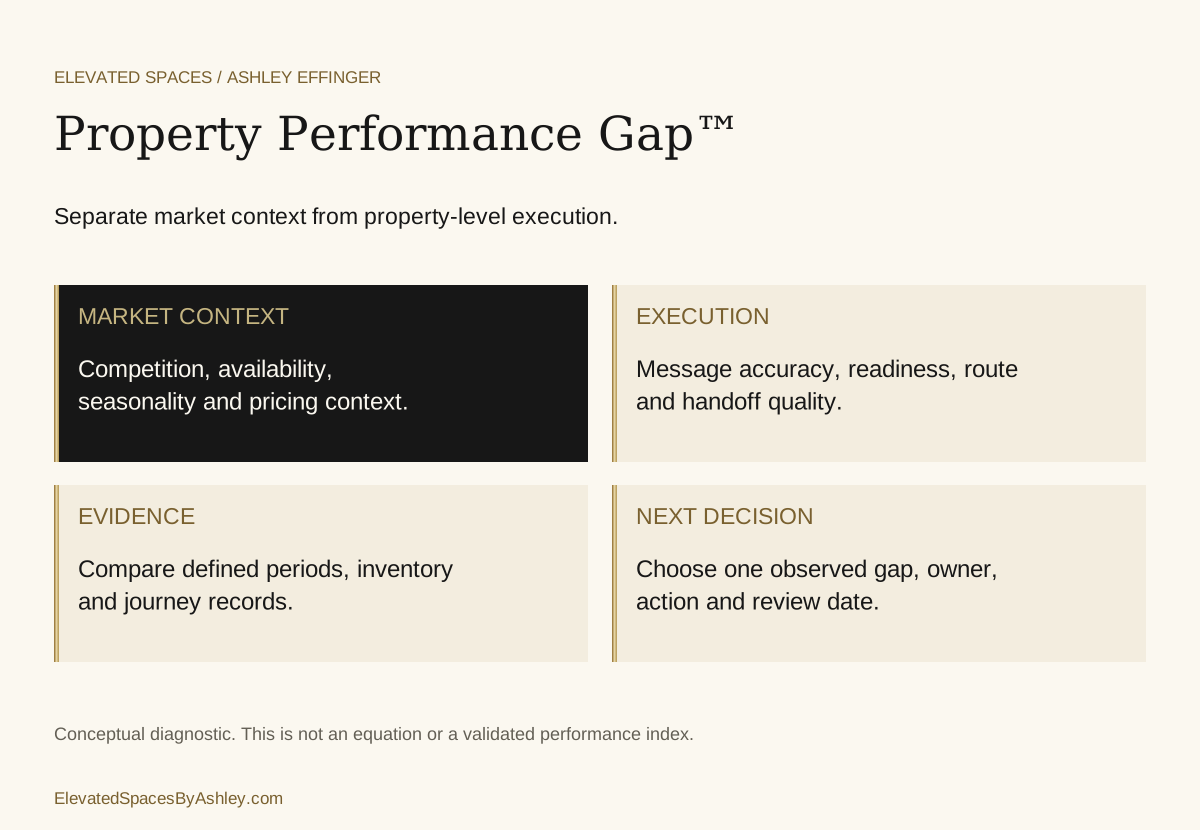
Read the framework as text
Property Performance Gap™. MARKET CONTEXT: Competition, availability, seasonality and pricing context.. EXECUTION: Message accuracy, readiness, route and handoff quality.. EVIDENCE: Compare defined periods, inventory and journey records.. NEXT DECISION: Choose one observed gap, owner, action and review date.
Follow the same people through the journey
Do not divide this week’s leases by this week’s inquiries and call it a clean conversion story. Those may be different people at different points in the journey. Follow a defined cohort where the records allow it, and label period activity honestly where they do not.
Avoid comparing this week’s inquiries with this week’s leases as though they necessarily represent the same people. For a meaningful journey review, follow a defined inquiry cohort over an agreed observation window.
If the records do not support that, label the report as period activity and explain the limitation.
Read concessions and effort alongside progression, using the property’s approved reporting definitions. A campaign may generate many questions that require staff to explain information the landing page could have supplied.
That repeated clarification is an operational clue even when the eventual occupancy result looks reassuring.
None of these observations establishes that marketing caused a leasing outcome. Pricing, availability, seasonality, service and external conditions can all contribute.
The value of the review is a better hypothesis about what to improve, followed by an observable test.
Make the report earn a decision
The Property Performance Gap™ asks the uncomfortable question: how much of this is market context, and how much is execution? A useful review investigates both. “The market” should be context, not a standing alibi for a broken handoff.
For an illustrative case, suppose inquiries for one layout regularly include questions about furniture placement. The next action could be a dimensioned, accurate visual and a revised tour explanation.
The review would look for fewer unanswered layout questions and clearer progression, without pretending a small sample proves a universal conversion lift.
If the data is too weak to support a change, make data clarification the assignment. Establishing a consistent definition or fixing missing stage records may be more valuable than commissioning another campaign.
A confident recommendation should have a visible connection to the evidence available.
The upcoming Property Performance Gap framework is designed to organize that distinction between market context and execution questions. Until it is released, use a simple decision log.
A full building deserves thoughtful stewardship of the next leasing decision, too.
Multifamily Marketing KPI Dictionary
Agree on what the metric counts before interpreting the result or deciding the next action.
Get the KPI DictionaryRelated published work
Continue with Ashley’s original articles. This website companion focuses on practical implementation.
- PPC Clicks Don’t Lease Apartments. Alignment Does. · Elevated Spaces on LinkedIn